NASA's new deep-space dish keeps its sensitive receivers underground
DSS-23 is already tracking spacecraft from California. Its beam-waveguide design adds capacity while moving delicate electronics off the moving antenna.

A spacecraft can cross millions or billions of kilometres and still depend on a rather ordinary final step: its radio signal has to reach the right dish on Earth at the right time. The weaker the signal and the busier the schedule, the more valuable another precise, flexible antenna becomes.
NASA has now put one into regular service at its Goldstone Deep Space Communications Complex near Barstow, California. Deep Space Station 23, or DSS-23, is a 34-metre dish and the newest addition to the Deep Space Network. NASA says it began operations on 3 August after a test campaign that ran from May through July.
Its first operational tracking assignment was the Chandra X-ray Observatory. The agency says DSS-23 has since communicated with dozens of missions, including Mars Reconnaissance Orbiter, Psyche, Juno and Voyager 1. That list makes the milestone sound like a story about size. The more revealing feature is where the antenna puts its sensitive equipment.
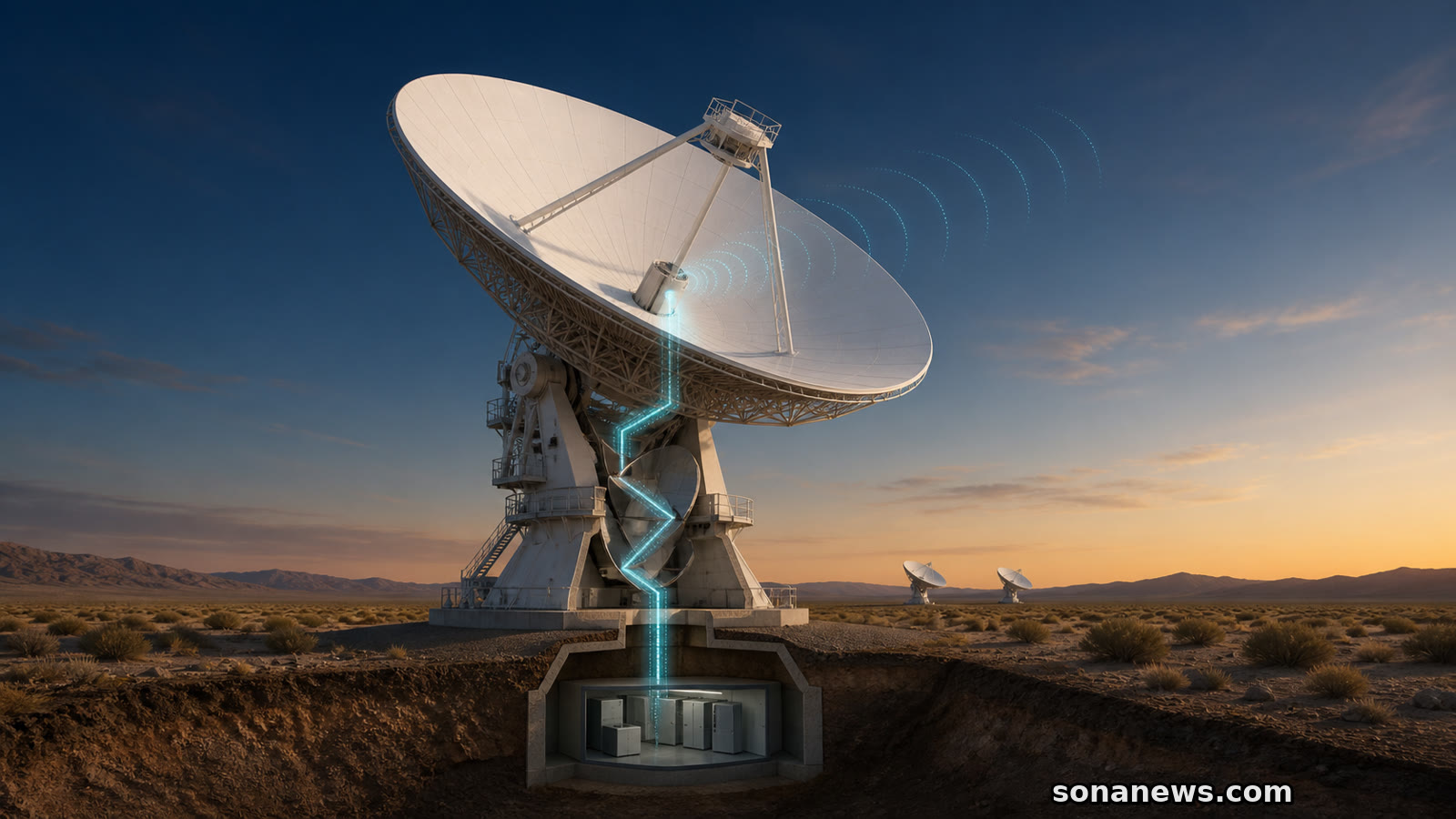
DSS-23 is a multifrequency beam-waveguide antenna. Its large curved reflector collects an extremely faint radio signal and directs it towards a smaller subreflector. A sequence of reflectors then carries the radio-frequency energy down through the pedestal to receivers in a stable, climate-controlled room underground.
That arrangement avoids placing as much heavy, delicate electronic equipment on the structure that has to turn and tilt. It also gives technicians easier access for maintenance and future upgrades. The giant dish remains the part visible across the desert, but the room below is one reason the system can be adapted to different radio frequencies and missions.
The illustration above simplifies that route. It is not an engineering drawing of DSS-23, and the cyan path represents an invisible radio signal rather than a visible beam. NASA's own photographs provide the accurate documentary record of the completed antenna at Goldstone.
Building the structure was only part of the job. Construction started in February 2020. In December 2024, crews placed a 133-tonne metal reflector framework on top of the antenna's pedestal, then fitted the panels that form its radio-reflecting surface. Engineers still had to integrate mechanical systems, electronics, software, radio-frequency hardware and site infrastructure, then calibrate the dish to work with the rest of the network.
That long integration period explains the gap between a dramatic construction image and an operational antenna. For a deep-space link, small pointing or calibration errors matter. A dish is useful only when its subsystems behave as one reliable instrument and when mission controllers can schedule it alongside other antennas.
DSS-23 is now the fifth antenna at Goldstone. It joins three other 34-metre dishes and one 70-metre dish. It is also the fifth of six antennas in NASA's Aperture Enhancement Project, an expansion effort that began in 2009.
The final planned addition is Deep Space Station 33 in Canberra, Australia, which NASA expects to bring online in 2029. At that point, the network is due to have 13 of the newer 34-metre antennas across its three complexes.
Adding a dish does not give every mission an uninterrupted connection. Spacecraft still have to be above the local horizon, use compatible frequencies and share scheduled time. Nor does DSS-23 replace the 70-metre antennas, which remain the network's largest and most sensitive dishes.
The smaller antennas can, however, work together. Arraying combines their receiving power so several dishes act as a larger collecting system. NASA says groups of 34-metre antennas can provide a communications backup equivalent to each complex's single 70-metre dish. That matters because the 70-metre antennas have operated almost continuously for more than 50 years and are becoming more expensive to maintain.
Arraying is not just a future idea. In April 2024, all six antennas at the Madrid complex received Voyager 1's signal together during a test. The exercise showed how several dishes can collect a signal that has become extraordinarily faint after travelling through interstellar space.
Goldstone is one point in a global relay. The Deep Space Network also operates complexes near Madrid, Spain, and Canberra, Australia. The three sites sit roughly 120 degrees apart in longitude. As Earth rotates and a spacecraft drops below one site's horizon, another site can take over the link.
That geography is why a new California dish cannot be treated as a network-wide cure. Capacity depends on which part of the sky a mission occupies, which station can see it and what other spacecraft need contact. Canberra also has a distinctive southern view that is essential for some trajectories, including Voyager 2.
NASA says more than 100 NASA and non-NASA missions rely on the Deep Space Network and the separate Near Space Network together. The ground infrastructure has to support commands going out, engineering information coming back and the science data missions were built to collect. Those links are easy to overlook because they do not produce a launch plume or a new picture of another world.
DSS-23's achievement is quieter. It has moved from construction and calibration into the schedule, while its receivers sit in an accessible room beneath the desert. For missions far from Earth, another well-calibrated hour on a dish can be the difference between data stored aboard a spacecraft and data that scientists can actually use.
Sources
- Source: "New Next-Gen Dish Adds Muscle to NASA's Deep Space Network", NASA, Extracted 30 August 2026. Verified the 3 August operational start, May to July testing, first Chandra track, subsequent mission list, 34-metre size, Goldstone antenna count, construction history, underground beam-waveguide room, arraying role and planned Canberra completion in 2029
- Source: "NASA Deep Space Network's New Goldstone Antenna Goes Online", NASA Science Photojournal, Extracted 30 August 2026. Verified the completed August 2026 antenna, Goldstone location, 34-metre multifrequency beam-waveguide description, Aperture Enhancement Project context and the accurate documentary appearance of DSS-23
- Source: "Deep Space Network", NASA, Extracted 30 August 2026. Verified the network's command, tracking, navigation and science-data roles, plus its three facilities and global handover logic
- Source: "NASA's Deep Space Network Starts New Dish, Marks 60 Years in Australia", NASA Jet Propulsion Laboratory, Published 8 April 2025 and extracted 30 August 2026. Verified DSS-33's planned 2029 service, the underground climate-controlled beam-waveguide equipment arrangement, three-site geometry and Canberra's distinctive Voyager 2 visibility
- Source: "Six Deep Space Network Antennas in Madrid Arrayed For the First Time", NASA Jet Propulsion Laboratory, Published 29 April 2024 and extracted 30 August 2026. Verified the six-antenna Voyager 1 array test and the purpose of combining several antennas to receive a very faint signal
Help us improve
Was this article useful?
One anonymous tap helps Sona improve future reporting, headlines and source context.
Up next

NASA is moving towards a final pre-flight telescope for the ESA-led gravitational-wave mission. Its amber glass-ceramic structure matters as much as its gold mirror.
Continue readingMore in Space