The Milky Way's 11.8-billion-year-old merger survives in its star clusters
Hubble and Gaia did not photograph the ancient collision. Researchers separated 39 inner globular clusters by age, metal content and motion, finding evidence for a large lost dwarf galaxy called LKH.
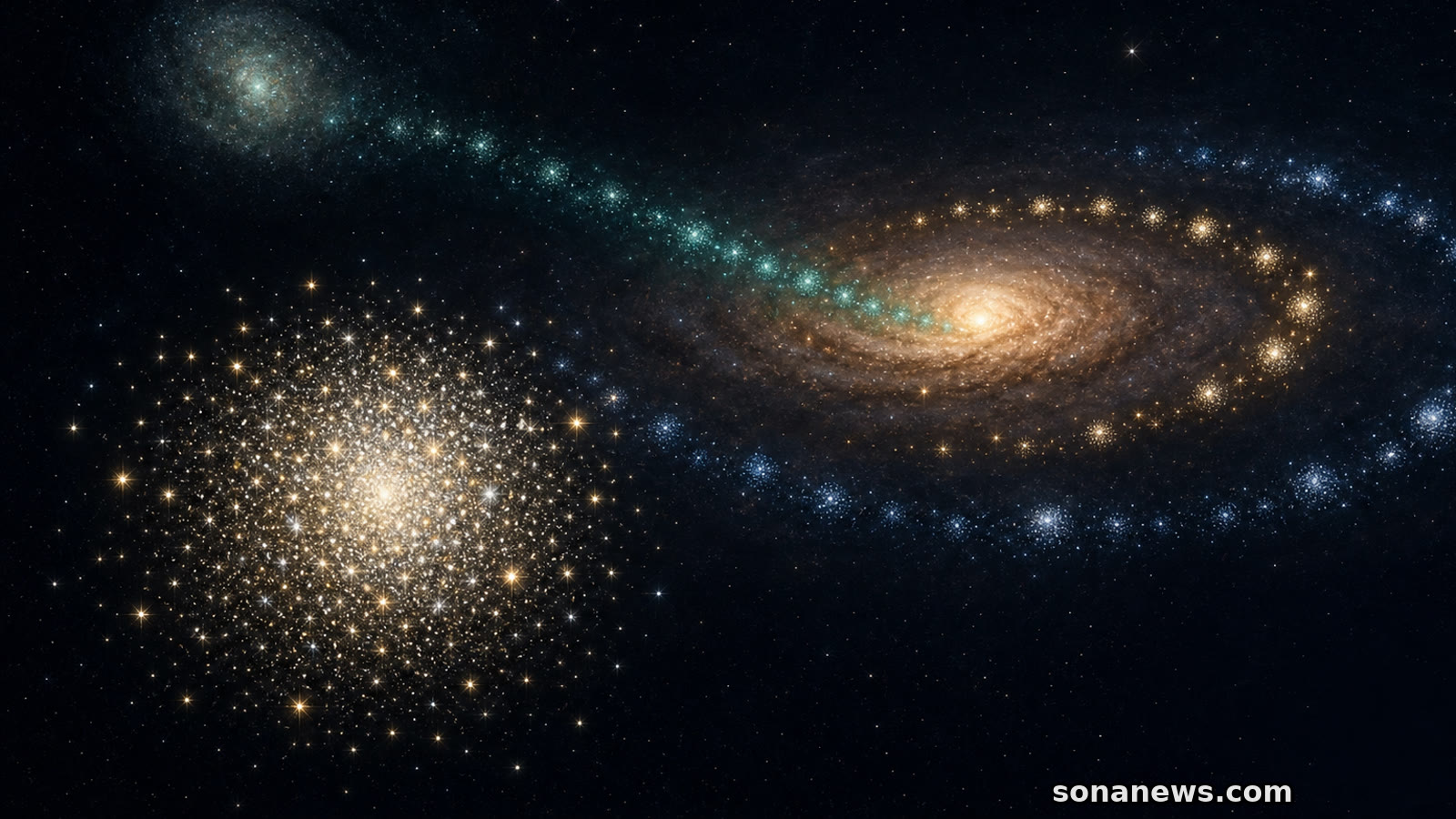

The Milky Way keeps no intact photograph album of its childhood. Instead, astronomers have to date the pieces that survived and work out which ones arrived together.
A study published in *Nature Astronomy* on 17 August says one of those surviving records is a distinct family of globular clusters in the inner galaxy. By comparing precise cluster ages and metal content from the Hubble Space Telescope with measurements associated with ESA's Gaia mission, the researchers identified evidence for a major merger about 11.8 billion years ago. That is roughly 1.8 billion years earlier than the better-known Gaia-Sausage-Enceladus merger.
The lost dwarf galaxy has been named Low-energy-Kraken-Heracles, or LKH. The cumbersome title is deliberate. It joins three labels used in earlier studies that had each pointed towards some kind of early accretion event. The new work argues that those disputed clues belong to the same substantial episode in the Milky Way's assembly.
This is not Hubble looking back and photographing two galaxies colliding. It is galactic archaeology: using the ages, chemical character and present-day arrangement of old star clusters to reconstruct an event whose original galaxy has long since been pulled apart.
Globular clusters are dense, roughly spherical gatherings that can contain tens of thousands to millions of stars. Many are extremely old. Because a cluster's stars formed together, the group can preserve a cleaner chronological and chemical signal than a mixed field of individual stars.
The team analysed Hubble observations of 39 globular clusters within the inner 20,000 light-years, or about six kiloparsecs, of the Milky Way. This is where traces of a very early merger might remain, even after billions of years of mixing in the busy central galaxy.
The key result was not a single unusual cluster. It was three separate age-metallicity sequences across the sample. Metallicity is the astronomical term for the abundance of elements heavier than helium. One sequence is associated with clusters formed in the Milky Way's own main progenitor. Another is linked to Gaia-Sausage-Enceladus, the large dwarf galaxy absorbed around 10 billion years ago. Between them in age sits a third sequence.
That third family is older than the Gaia-Sausage-Enceladus group but younger than clusters attributed to the Milky Way itself, across its range of metal content. The paper interprets the pattern as a separate incoming system rather than a continuation of either known population.
The researchers estimate that LKH carried about 500 million solar masses in stars, similar in scale to Gaia-Sausage-Enceladus, and deposited most of its stellar mass within the inner six kiloparsecs of the Milky Way. At that early date, our galaxy was much smaller than it is now, so the encounter represented a significant addition rather than a minor snack.
Reconstructing the youngest Milky Way is difficult precisely because the participants were less different from one another. A small early Milky Way and a substantial dwarf companion could have comparable sizes. Their stars have since orbited through the central galaxy for nearly 12 billion years, while the Milky Way's rotating bar and other gravitational changes scrambled much of the original dynamical pattern.
Chemistry helps, but it is not a perfect family name. Similar abundance patterns can emerge in stars born inside the early Milky Way and in stars delivered by another young galaxy. That ambiguity fed the argument over whether groups previously called Kraken, Heracles or the low-energy population were truly accreted or formed in place.
The study's advantage is chronological. Hubble's deep, high-resolution imaging allowed the team to measure relative cluster ages with enough precision to separate the sequences. Gaia measurements then add information about how clusters move through the galaxy. Neither dataset tells the story alone. The inference comes from the population pattern produced when age, metal content and dynamics are considered together.
That also sets the right boundary for the claim. LKH is a reconstructed progenitor, not a surviving dwarf galaxy that can be photographed today. Its estimated mass and merger time come from models fitted to the cluster evidence. The peer-reviewed paper calls the third sequence evidence that resolves earlier debate, but future observations can still refine which clusters belong to it and whether the earliest assembly involved one dominant event or more than one closely timed merger.
The result matters because it changes the balance between stars born at home and stars brought in from elsewhere. Some accounts of the Milky Way's earliest phase emphasised an in-place population forming in a turbulent young galaxy. LKH indicates that external stars were already an important part of the inner Milky Way about two billion years after the Big Bang.
It also turns globular clusters into more than decorative objects around the galaxy. A single cluster is a compact fossil. A carefully dated population can become a construction sequence, revealing which batches of stars arrived before others even when the parent galaxies have vanished.
The researchers plan to extend that sequence with Hubble observations of clusters that have not previously received the same treatment. The useful test will be whether those additional ages sharpen the three existing families, expose subgroups within LKH or uncover another piece of the merger record.
For now, the study pushes a well-supported chapter of Milky Way history 1.8 billion years farther into the past. The ancient collision itself is gone. Its timetable remains, encoded in clusters still circling the galaxy it helped to build.
Sources
- Source: "Evidence of a massive accretion event 1.8 billion years before the Gaia-Sausage-Enceladus merger", *Nature Astronomy*, Extracted 2026-08-23. Verified from the open peer-reviewed article: three age-metallicity sequences; Hubble-based precise relative ages; an event 1.8 billion years before Gaia-Sausage-Enceladus; an estimated progenitor of about 500 million stellar masses; deposition mainly within the inner six kiloparsecs; LKH naming; publication and review status
- Source: "Hubble Solves Merger Mystery From Milky Way's Early Years", NASA Science, Extracted 2026-08-23. Verified: analysis of 39 globular clusters in the inner 20,000 light-years; merger timing near 11.8 billion years ago; relationship to Gaia-Sausage-Enceladus; roles of cluster ages, metal content and Gaia measurements; study-team interpretation and planned follow-up
- Source: "Hubble solves merger mystery from Milky Way's early years", ESA/Hubble, Extracted 2026-08-23. Verified: independent mission-partner summary, 17 August 2026 release, globular clusters as archaeological sites, three-population interpretation, mass estimate, terminology and explicit link to the Nature Astronomy paper
- Source: "Hubble & Gaia solve our galaxy's merger mystery", European Space Agency, Extracted 2026-08-23. Verified: Hubble and Gaia context, the earlier debate, inner-cluster sample, merger chronology and distinction between in-place and externally formed early stars
Help us improve
Was this article useful?
One anonymous tap helps Sona improve future reporting, headlines and source context.
Up next
NASA is moving towards a final pre-flight telescope for the ESA-led gravitational-wave mission. Its amber glass-ceramic structure matters as much as its gold mirror.
Continue readingMore in Space