Moon shadow niches may let Earth microbes survive, not grow
A new model finds cold, low-ultraviolet pockets near the lunar south pole where some organisms from Earth might remain viable for a day. It is a contamination question, not evidence of lunar life.
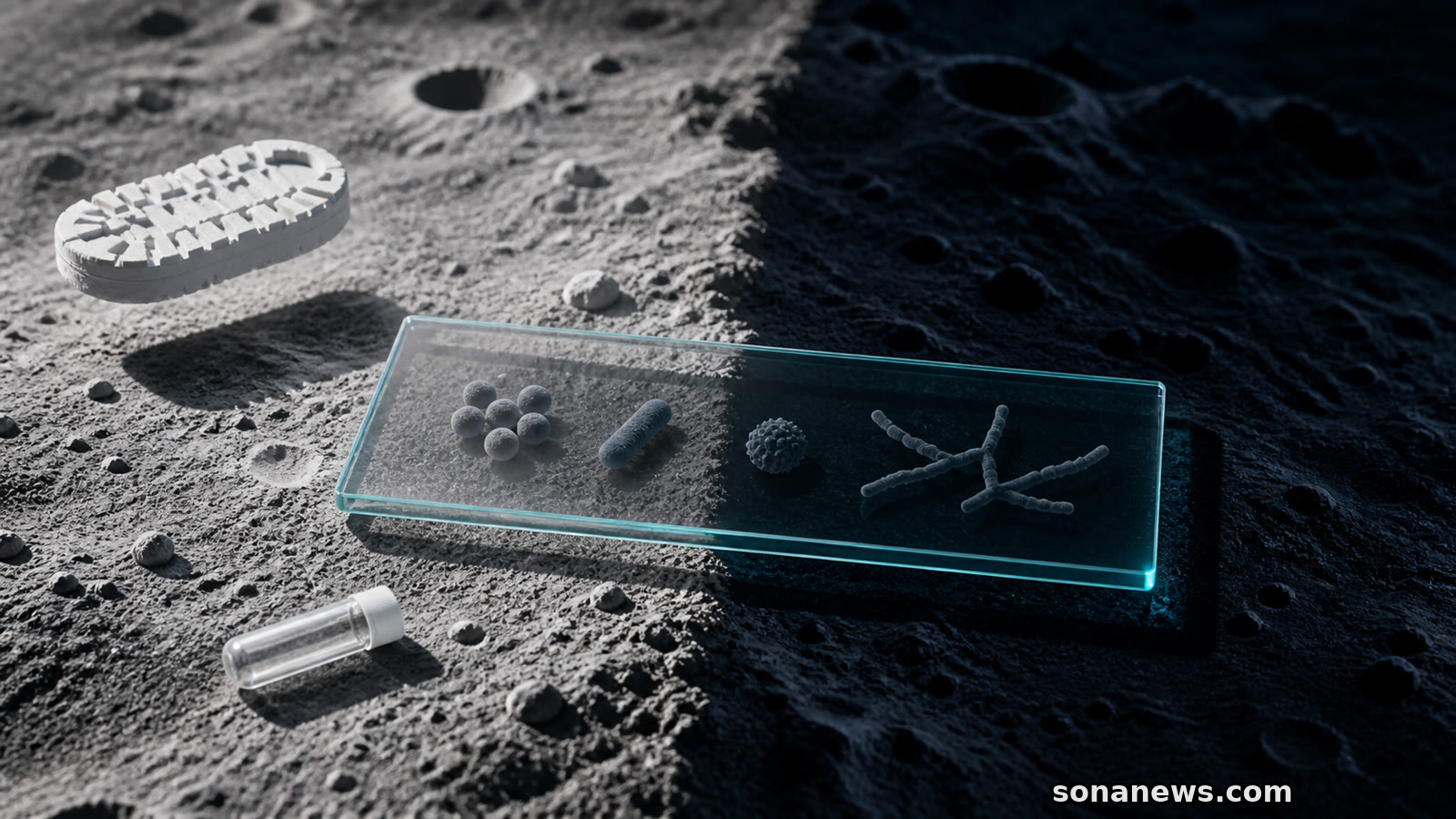

Survival is not the same as a habitat. That distinction is the most important result to carry away from a new study of possible microbial niches near the Moon's south pole.
The NASA-backed research, published in *Science Advances* on 19 August, combines remote observations of lunar terrain with high-resolution illumination modelling. The team compared the resulting temperature and ultraviolet conditions with laboratory evidence about organisms likely to travel with people and equipment. Its conclusion is bounded: some polar surfaces may be mild enough for certain Earth microbes to remain viable for at least one Earth day.
The paper does not report a sample from the Moon, a living colony or an organism reproducing in lunar soil. Its authors describe possible survival in a cryptobiotic state, an inactive condition in which growth could resume only if a suitable environment later appeared. That makes the finding relevant to contamination control, but it is not evidence of native lunar life.
Most exposed lunar terrain remains exceptionally hostile. There is no atmosphere to soften ultraviolet light, temperatures can be extreme, and energetic radiation reaches the surface. Earlier human exploration took place near the lunar equator, while planned crewed missions are aimed at the much more topographically varied south polar region.
Low-angle sunlight changes the geometry there. A large crater floor can stay dark for long periods, but a small ridge, rock or depression can also cast a local shadow. The study used that terrain and illumination pattern to look for places where temperature and ultraviolet exposure fall within experimentally observed survival limits.
NASA's account of the work says the potential niches range from large crater areas to small shadowed patches comparable in scale with future footprints. That does not mean every shadow is safe for every organism. A modelled match to two environmental thresholds is a screening result, not a complete simulation of vacuum, radiation, dust chemistry and the many ways cells are damaged over time.
The one-day threshold matters for the same reason. It gives researchers an operational definition they can test around a mission, rather than claiming indefinite persistence. The study's abstract says polar areas may be less hostile than previously assumed, but explicitly separates survivability from the likelihood of growth.
Humans and their machines carry biological and organic material even after careful cleaning. Suits, airlocks, vents, tools and habitats create more routes than an uncrewed lander. If a terrestrial organism can remain identifiable or viable for a while in a cold shadow, researchers later examining that location need to know what arrived, when it arrived and where operations took place.
That is a provenance problem before it is an ecosystem problem. A microbe brought from Earth would not become lunar life simply because it survived. Yet without a clean baseline and an activity record, a later detection could be harder to interpret. The scientific cost would be uncertainty about whether a signal belonged to the Moon's history or to the expedition that measured it.
The same logic applies to non-biological organics. Thruster products, adhesives, lubricants, plastics and material released by equipment can enter a cold trap or a sample. An inventory cannot prevent every transfer, but it gives future investigators a record against which to compare an unexpected finding.
The study does not itself change NASA policy. A 2026 NASA planetary-protection guide says lunar requirements are based on reporting rather than sterilisation. Surface missions report propulsion products, and missions going to the lunar poles or permanently shadowed regions also report organic materials. The guide says there are no limits on the types or quantities of organics and no biological restrictions on lunar mission design or landing sites.
That policy reflects a different question from the new model. NASA's guide says the lunar surface does not support the proliferation of terrestrial organisms. The paper asks whether some organisms could persist without proliferating in unusually cold, low-ultraviolet pockets. Those two statements can both be true.
NASA's broader planetary-protection handbook describes such records as a way to preserve the scientific value of later measurements. The new research sharpens where baseline sampling and operational logs might matter most, but any revision to requirements would need a separate policy process. A peer-reviewed map is evidence for discussion, not a rule announcement.
The next useful evidence would come from a comparison designed before a busy surface campaign. Researchers would need samples from an area before nearby human activity, samples after defined operations, and precise records of materials, movement and time. They would also need controls that distinguish a viable cell from biological residue that can no longer function.
That design would answer a series of narrower questions. Did anything from Earth reach the shadow? Did it remain detectable? Was it still viable after one day or longer? Could it reactivate under laboratory conditions? None of those answers, alone, would show growth on the Moon.
Readers can use the same ladder when evaluating future headlines. First ask whether a claim comes from a terrain model or an actual lunar sample. Then ask whether the evidence shows detection, viability, growth or reproduction. Finally, check the time window and whether mission policy has changed. Those words mark very different levels of evidence.
For now, the study turns a seemingly empty patch of darkness into a record-keeping problem. The Moon has not been shown to host life in its polar shadows. The finding is that a small number of visitors from Earth might not disappear as quickly as researchers once assumed, which makes the untouched sample and the first activity log more valuable.
Sources
- Source: "Potential survivable niches for microbial life on the lunar south pole", *Science Advances*, Extracted 2026-08-20. Verified from the publisher's Crossref record: peer-reviewed article title, 19 August 2026 online publication, NASA funding, remote-sensing and illumination-model method, comparison with microorganism survival evidence, polar niche conclusion, cryptobiotic-survival boundary and explicit exclusion of growth likelihood
- Source: "Human-Related Microbes May Survive Moon's South Pole, NASA Finds", NASA Science, Extracted 2026-08-20. Verified: one-Earth-day operational threshold, focus on organisms likely to accompany crewed exploration, effect of cold and low ultraviolet exposure, local topographic shadow at large and footprint-like scales, and the distinction between survival and active growth
- Source: "A Quick Guide to Planetary Protection on the Moon", NASA Office of Safety and Mission Assurance, Extracted 2026-08-20. Verified: current reporting-only approach, propulsion-product inventories for surface missions, organic inventories for polar and permanently shadowed destinations, no quantity limits, and the present conclusion that lunar conditions do not support terrestrial-organism proliferation
- Source: "NASA Planetary Protection Handbook", NASA Technical Reports Server, Extracted 2026-08-20. Verified: handbook purpose, current policy framework and the role of planetary-protection records in preserving scientific integrity for robotic and crewed missions
Help us improve
Was this article useful?
One anonymous tap helps Sona improve future reporting, headlines and source context.
Up next

NASA is moving towards a final pre-flight telescope for the ESA-led gravitational-wave mission. Its amber glass-ceramic structure matters as much as its gold mirror.
Continue readingMore in Space