NASA's Pandora is watching the stars that can imitate exoplanet atmospheres
The SmallSat has started science observations of at least 20 transiting worlds. Its long visible and infrared stares are designed to tell planetary chemistry from the changing face of a star.
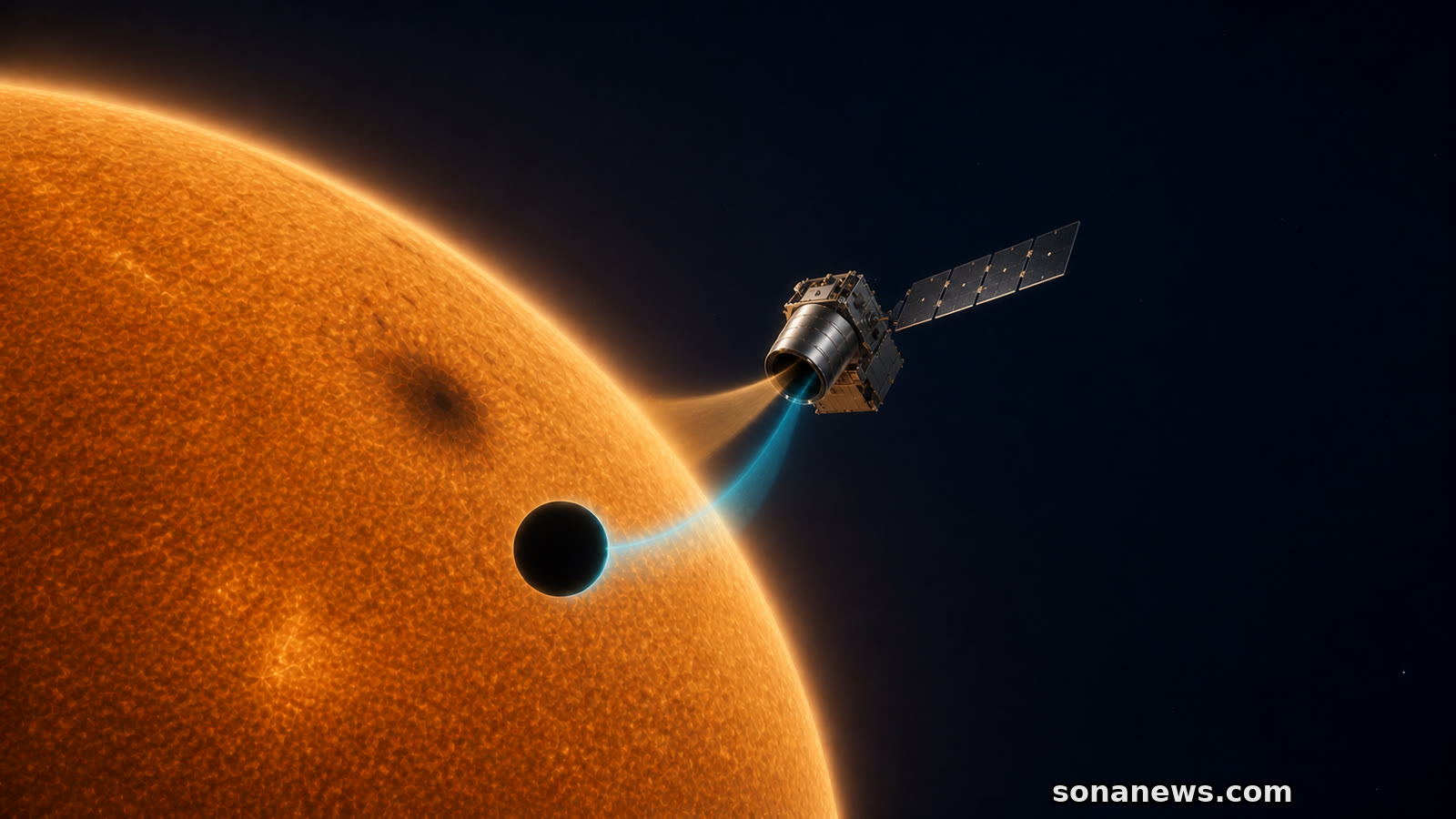

A planet passing in front of its star can reveal more than a tiny dip in brightness. Some of the starlight skims through the planet's atmosphere, where molecules absorb particular wavelengths. That pattern can become a chemical fingerprint of a world too distant to photograph as a globe.
There is a complication: the fingerprint begins with the star. A stellar surface is not a perfect, uniform lamp. Darker spots and brighter regions rotate in and out of view, grow and fade, and alter the mixture of light collected by a telescope. Those changes can imitate, hide or distort the features that astronomers hope belong to the planet.
NASA's Pandora mission has now begun science observations aimed directly at that problem. The agency said on 25 August that the SmallSat is healthy and its instruments are performing as intended following its 11 January launch and commissioning. During its one-year primary mission, Pandora is scheduled to study at least 20 transiting exoplanets and the stars they orbit.
The mission is not announcing that it has found water, life or even a new planet. Its job is more fundamental: learn the changing face of each host star well enough that atmospheric measurements can be interpreted with greater confidence.
Transmission spectroscopy compares starlight collected during a transit with the star's light outside the transit. The difference is extremely small. Only a fraction of the total light has passed through the planet's atmosphere, while the telescope also receives light from the rest of the visible stellar surface.
That surface can include cool, dark spots and hotter, brighter areas called faculae. If the planet crosses one part of the star while unocculted spots sit elsewhere, the apparent transit depth can change with wavelength. In a spectrum, stellar features can then resemble or suppress atmospheric absorption.
Water is a particularly important example. Pandora team member Benjamin Rackham told NASA that features on a star can distort the water signal researchers are seeking. That does not mean every reported water feature is wrong. It means the star and planet have to be modelled together before a planetary interpretation earns confidence.
The problem grows more important as astronomers move from large, puffy planets towards smaller worlds with thinner atmospheric signals. A host star's uneven surface can be larger than the effect being measured. More sensitive telescopes do not automatically remove that ambiguity; they can measure the mixed signal more precisely.
Pandora's answer is simultaneous coverage. Its 45-centimetre, all-aluminium telescope measures a star's brightness in visible light while collecting a near-infrared spectrum at the same time. The visible record helps track how spots and bright regions change as the star rotates. The infrared channel covers wavelengths where planetary atmospheric features, including water absorption, can appear.
Taking the two views together matters. If the visible brightness changes while an infrared feature shifts, researchers gain constraints on how much of the signal came from the star. Observations made at different times with different instruments would be harder to compare because the stellar surface may have changed between them.
Time is Pandora's other advantage. NASA's plan calls for observing each target 10 times, with each stare lasting about 24 hours and including a transit. That long baseline captures the star before, during and after the planet crosses, rather than treating the transit as an isolated event. Across at least 20 targets, the core programme amounts to a minimum of 200 long observing sessions.
The spacecraft carries a spare near-infrared detector originally developed for the James Webb Space Telescope. Yet Pandora is not a smaller replacement for Webb. Webb can take far deeper and broader spectra, but its observing time is intensely sought after. Pandora is designed to spend repeated, long stretches characterising the stellar context that a flagship observatory cannot routinely devote to every target.
Combining the missions is the point. A better model of the host star can help researchers revisit Webb spectra and separate stellar contamination from the planet's atmospheric signal. Pandora's science data will also be archived through the NASA Exoplanet Archive, allowing researchers beyond the core team to test methods against the same long-baseline observations.
Pandora is the first satellite launched through NASA's Astrophysics Pioneers programme, which funds comparatively low-cost, faster missions with more tolerance for risk than a flagship project. Its telescope and spacecraft were assembled around existing technologies, including the Webb spare detector and a commercial satellite bus.
That approach makes the current milestone significant but also sets the right limit on the story. NASA says science observations have started and the hardware is healthy. The agency has not yet published a catalogue of corrected planetary atmospheres from the mission, and the illustration above is not one of Pandora's targets or a real measurement.
The eventual test will be in the data. Researchers will need to show that repeated visible and infrared observations can constrain stellar spots and faculae, then demonstrate how those constraints change atmospheric interpretations. Some targets may yield clearer separations than others, and a cleaner spectrum will not by itself establish habitability or life.
Pandora's premise is deliberately less dramatic than a single discovery image. Before asking what an exoplanet's atmosphere contains, astronomers have to understand the light source behind it. For the next year, a small telescope in low Earth orbit will spend unusually long hours watching that source change.
Sources
- Source: "NASA's Pandora Mission Begins Study of Exoplanets, Host Stars", NASA Science, Published 25 August 2026 and extracted 27 August 2026. Verified the active science milestone, spacecraft health, launch date, at-least-20 target programme, 10 roughly 24-hour observations per target, simultaneous visible and near-infrared method, 45-centimetre telescope, Webb spare detector, stellar-contamination rationale and NASA Exoplanet Archive availability
- Source: "Pandora", NASA Science mission page, Extracted 27 August 2026. Verified active-mission status, 11 January 2026 launch, one-year science plan, transit-spectroscopy explanation, host-star spot coverage method and first engineering-image context
- Source: "The Pandora SmallSat: A Low-Cost, High Impact Mission to Study Exoplanets and Their Host Stars", Barclay et al., 2025 IEEE Aerospace Conference, arXiv:2502.09730, Extracted 27 August 2026. Verified the instrument design, simultaneous visible photometry and near-infrared spectroscopy, mission objectives, stellar-contamination mechanism and planned observing cadence. The paper describes the pre-launch design, so post-launch status is taken from NASA's August 2026 update
- Source: "Exoplanets in Reach", Lawrence Livermore National Laboratory, Extracted 27 August 2026. Verified the transmission-spectroscopy explanation, engineering choices, commercial bus, all-aluminium CODA telescope, detector heritage and complementarity with Webb. Current operational claims were checked against the later NASA release
Help us improve
Was this article useful?
One anonymous tap helps Sona improve future reporting, headlines and source context.
Up next
NASA is moving towards a final pre-flight telescope for the ESA-led gravitational-wave mission. Its amber glass-ceramic structure matters as much as its gold mirror.
Continue readingMore in Space