Iceland's F-road season ends with a live status check, not a calendar date
Highland roads usually close around mid-September, but weather, route status and the vehicle still decide whether an itinerary works.
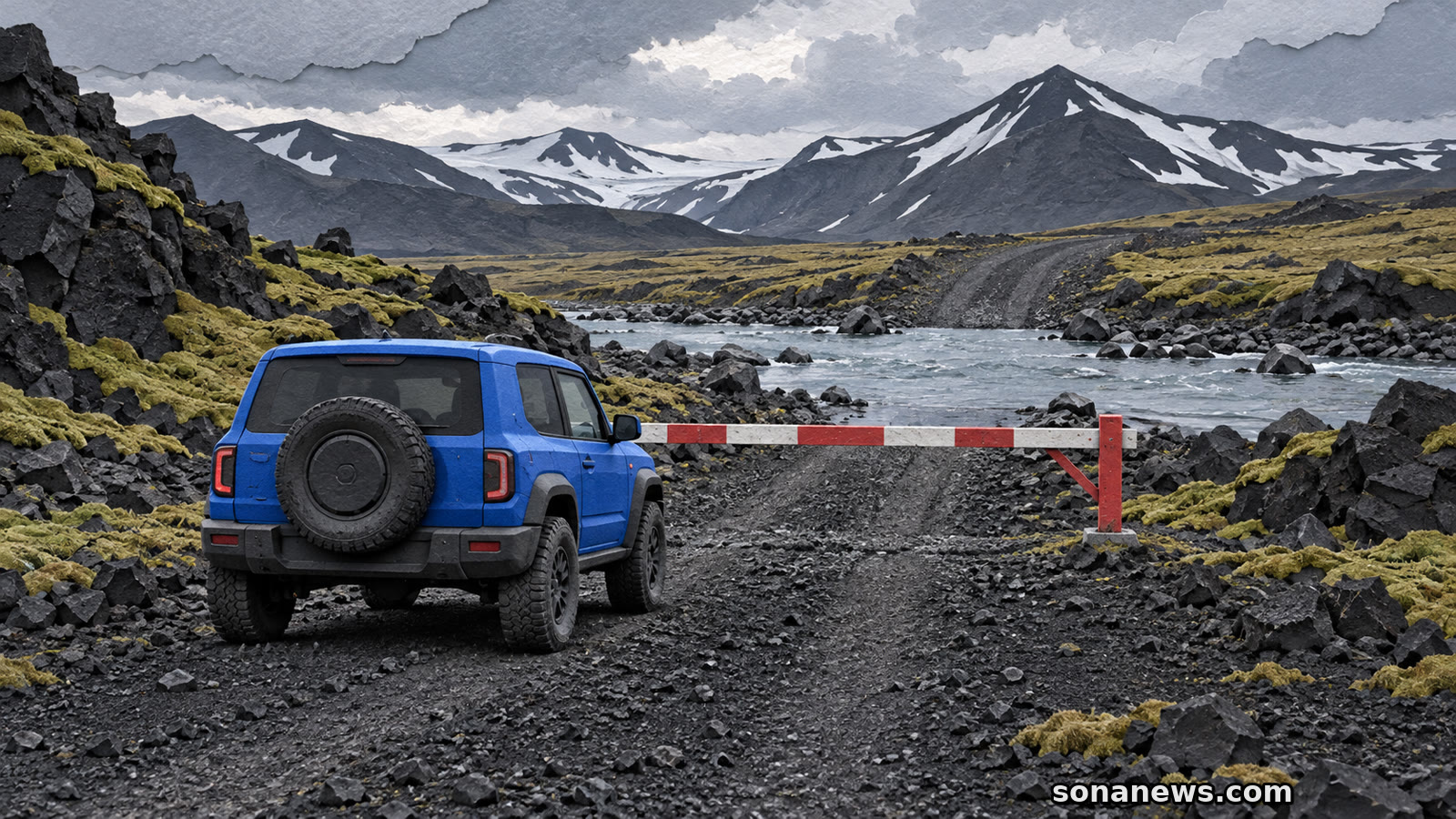

An Iceland road trip can look settled on a booking screen: a rental car, a night in the highlands and a route line joining the two. In September, that line needs another layer of evidence.
Safetravel, the official visitor-safety service run by the Icelandic Association for Search and Rescue, says highland F-roads are usually closed from mid-September until June or July. The wording matters. "Usually" is not a universal closing date, and a road shown on a general navigation app is not proof that it is open or passable.
The useful habit is to use the live status at Umferdin, the Icelandic Road and Coastal Administration's traffic service, as part of the journey rather than as a final glance after the itinerary is fixed.
Iceland's Road and Coastal Administration says mountain-road opening depends chiefly on snow cover. Wet ground can also delay access, and roads through conservation areas may remain closed until the wider area can withstand visitors. Its Highlands Map is updated as conditions change.
That official explanation is written around spring opening, but it reveals the larger principle at both ends of the short season: access follows conditions. Safetravel describes the roads as usually closed around mid-September, while also directing travellers to check whether the F-roads in their area are open.
A historic opening table, a travel blog or last year's trip report can help explain the shape of a season. None can establish today's status. Even a rental booking made months ago cannot do that.
The letter F describes a mountain-road category, not a promise that every vehicle marketed as a four-wheel drive can use every route.
The Road and Coastal Administration says an F-road can be exceptionally uneven, rough or steep, and may include one or more unbridged river crossings. Safetravel is equally direct that not all four-wheel-drive vehicles are suitable for all F-roads. Some routes may be manageable only with substantially larger or modified vehicles.
That creates two separate checks. One is whether the road is currently open. The other is whether the particular vehicle, rental agreement and route conditions are compatible. Passing the first does not answer the second.
A calm question to the rental company is more useful than relying on a vehicle silhouette in an advert. The route number and planned date make that question concrete. Contract exclusions and current official restrictions matter more than a generic "4x4" label.
An unbridged river is not a decorative detail on an Iceland itinerary. Safetravel says currents and depths change constantly and that rivers can become impassable. Its clearest instruction for uncertainty is to turn around rather than force a crossing.
This article cannot turn that variable situation into remote driving advice. A photograph, forum comment or successful crossing earlier in the day does not establish the depth, current, riverbed or vehicle suitability later. Official status, local information and the limits of the driver and vehicle remain decisive.
The distinction is especially important when a route looks open on one service but a river or weather warning changes the practical journey. A map line may describe geography without describing today's risk.
Turning off the marked track to get around snow, mud, a barrier or difficult ground is not an alternative route. Iceland's Environment Agency says travellers should drive only on roads and marked tracks, respect seasonal restrictions and walk or turn back when continuing by vehicle is not feasible. Off-road driving is prohibited under Iceland's Nature Conservation Act.
The reason is visible in the landscape. Volcanic soil is loose, vegetation grows slowly and tyre marks can persist for years or decades. The Road and Coastal Administration also warns that premature traffic can damage thawing mountain roads and the surrounding ground.
That makes a closure more than an inconvenience imposed on a capable car. It protects both people and a surface that may not yet, or no longer, tolerate traffic.
The practical improvement is not to predict the precise closing day. It is to keep the highland segment conditional.
Check the route on Umferdin before committing to it and again on the day. Read Safetravel's current conditions and alerts rather than relying only on a general navigation app. Confirm the exact route with the rental provider, not simply the vehicle class. Keep accommodation and timing flexible enough to use a lower-level route if the highland section is closed or unsuitable.
This is not a call to abandon an autumn trip to Iceland. It is a reason to separate the destination from one fragile route. A plan that still works without the F-road is more durable than a plan that treats an uncertain road as the only bridge between bookings.
No. Safetravel says they are usually closed from mid-September until June or July, while the Road and Coastal Administration explains that access follows conditions. The live road service, not a single nationwide calendar date, is the operational check.
No. Safetravel says not all four-wheel-drive vehicles are suitable for all F-roads. Travellers also need to check the exact route, live status and the rental agreement.
Yes. Safetravel warns that general navigation maps may not always reflect closed or impassable roads and recommends checking official road and weather information.
Appearance alone does not override an official closure or establish that a river crossing is safe. Respect closures, stay on marked tracks and turn back when the route is not feasible.
Editorial note. This article provides general travel-planning and road-safety information from official Icelandic sources checked on 14 September 2026. It is not a route clearance, vehicle assessment, legal opinion or river-crossing instruction. Road, weather and river conditions can change quickly. Check current official status and alerts, follow closures and local instructions, and use qualified local or rental-provider advice for the exact journey.
Sources
- Icelandic Road and Coastal Administration, “Mountain roads”, Extracted 14 September 2026. Verified: snow and wet-ground effects on opening; the condition map; and the statement that the Highlands Map is updated as conditions change
- Safetravel, “Highland driving”, Extracted 14 September 2026. Verified: rapidly changing conditions; rough roads and unbridged rivers; route-by-route vehicle differences; live-status check at Umferdin; usual mid-September to June or July closure pattern; turn-back guidance; and the off-road prohibition
- Icelandic Road and Coastal Administration, “Driving safely in Iceland”, Extracted 14 September 2026. Verified: use of live traffic information; strict closure policies; the late opening pattern; and the need for flexible planning when roads close
- Environment Agency of Iceland, “Driving in Uninhabited Areas”, Extracted 14 September 2026. Verified: fragile volcanic soil and slow recovery; seasonal restrictions; marked-road requirement; instruction to walk or turn back when driving cannot continue; and the legal prohibition on off-road driving
- Official Iceland traffic service, Checked 14 September 2026. Verified as the current live road-notification service linked by the Road and Coastal Administration and Safetravel. The article does not infer a route-specific status from the text-only extraction
Help us improve
Was this article useful?
One anonymous tap helps Sona improve future reporting, headlines and source context.
Up next

Foreign visitors receive their granted stay digitally after immigration. A valid SG Arrival Card email and the official retrieval portal now replace the old ink-stamp check.
Continue readingMore in Travel