Bennu's fragile salts explain why asteroid samples live in nitrogen
Some minerals in NASA's returned asteroid material changed after months in air. Keeping samples away from Earth's moisture preserves clues to ancient brines.
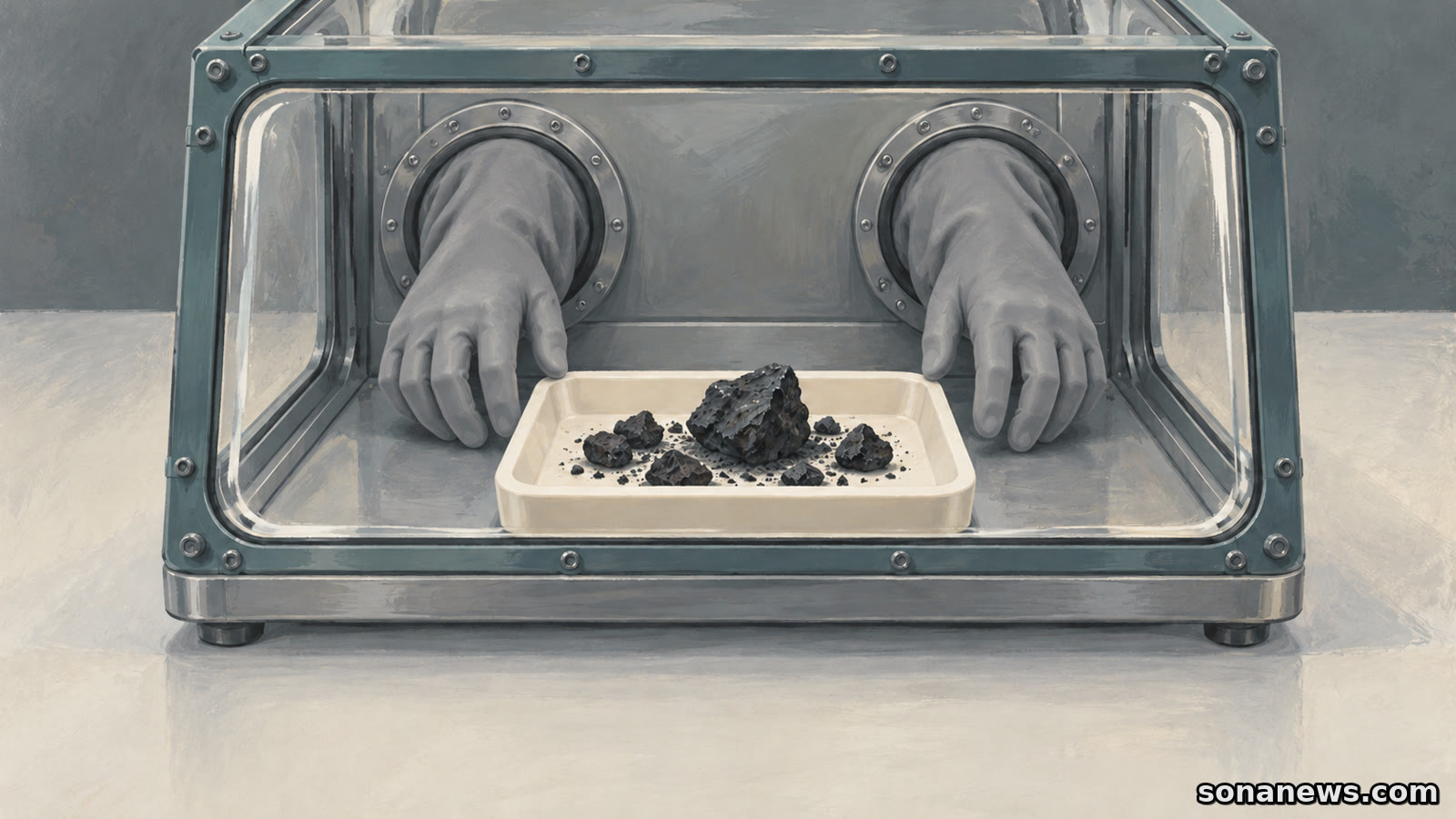

A rock can survive in space and still lose part of its scientific story after reaching a laboratory. In material returned from asteroid Bennu, researchers found salt grains that changed, or disappeared from the places where they had been observed, after months of storage in air. Comparable samples kept in nitrogen retained fragile mineral clues.
That contrast explains an easily overlooked part of a sample-return mission. Landing the capsule is not the end of protecting the evidence. The atmosphere around a grain, the materials beside it and the way it moves between containers can affect what researchers eventually measure.
The Bennu results were published in January 2025, not announced this week. They remain a useful guide to reading asteroid discoveries: before asking what an unfamiliar mineral says about space, ask how scientists established that Earth had not changed it.
The peer-reviewed study in Nature describes a range of salts in samples brought home by NASA's OSIRIS-REx mission in 2023. These included sodium-rich carbonates, sulfates, chlorides and fluorides, alongside other minerals recording interactions between rock and water.
The preservation problem was visible at the scale of individual grains. A hydrated sodium-calcium carbonate examined again roughly five months later, after continuous storage in an air-filled desiccator, showed extensive alteration. Sodium chloride had grown on its surface. In another particle, halite and sylvite grains seen earlier had disappeared after eight months in an air-filled autodesiccator, leaving voids.
Those observations do not mean every Bennu rock dissolves on contact with air. They concern particular, very small mineral phases under the storage conditions described in the paper. Nor were these jars left in the rain: the researchers report relative humidity of around 10 to 40 per cent for the air-storage observations. Even a laboratory storage environment can matter to sensitive material.
By contrast, samples stored in nitrogen at relative humidity far below one per cent retained sodium-rich evaporite phases, including sulfate, carbonate and fluoride. The authors argue that the full array of salts would not have been discovered without sample return and carefully controlled curation and storage during analysis.
NASA's curation specialists describe the practical arrangement in a 2025 technical conference abstract. Extraterrestrial collections at Johnson Space Center in Houston are stored and processed in gloveboxes and desiccators purged with high-purity nitrogen. The enclosures protect against alteration by terrestrial water and oxygen, as well as other forms of contamination.
A glovebox lets staff manipulate material through attached gloves while maintaining a separate atmosphere inside. Samples and tools pass through an antechamber rather than through an unrestricted opening to the room. For OSIRIS-REx, the technical description includes nitrogen purging and oxygen, humidity and pressure sensors that prevent the inner and outer doors being opened simultaneously.
The materials of the enclosure matter too. NASA's account explains why the choice of steel, window seals and glove material is restricted: the apparatus itself must not become an avoidable source of elemental or organic contamination. Even the interior finish has trade-offs, with highly reflective surfaces creating difficulties for detailed imaging.
This is not evidence that Bennu material is alive or dangerous. In the work described here, the barrier is protecting the sample's scientific value from Earth. Nitrogen storage also should not be read as a guarantee that every later experiment leaves a grain untouched. The study documents changes during analysis and storage precisely because that history affects interpretation.
The interest in these minerals is not that scientists found something resembling a kitchen ingredient. Different dissolved substances crystallise under different conditions. A collection of salts, their associations and their positions in a rock can help reconstruct the changing chemistry of a fluid.
The Nature team interpreted Bennu's late-stage salts as the residue of an ancient brine. This history belongs to Bennu's larger parent asteroid in the early solar system, not to a lake observed on the small rubble-pile asteroid today. Bennu inherited material from that earlier body.
Earth provides comparisons, rather than an exact duplicate. The researchers used mineral sequences from closed basins, including Searles Lake in California, to help interpret the asteroid material. They also acknowledged limits: the formation order of some Bennu phases was adopted from the terrestrial comparison where direct timing relationships in the sample were missing. A reconstruction is not a filmed record of an evaporating asteroid lake.
This is also why meteorites and returned samples answer overlapping but different questions. The paper notes that some salts have been found in meteorites, while terrestrial alteration can remove minerals or create new ones. A missing salt need not prove that the original asteroid lacked it. A salt present on Earth need not, by itself, establish when it formed.
NASA's announcement of the January 2025 research also discussed amino acids and nucleobases in the returned material. Such molecules are relevant to the chemistry used by life on Earth. The agency explicitly said the findings did not show evidence for life itself.
The mineral study addresses a different part of the story: the watery environments in which chemical reactions could have taken place, and the fragile evidence left behind. Preserving a salt helps researchers investigate that environment. It does not turn the salt into a fossil or establish that biology ever began there.
For readers following the next sample announcement, the useful questions are concrete. Was the material protected from terrestrial moisture? Did the researchers track changes after it left controlled storage? Are they reporting a measured mineral, a reconstructed ancient environment or a claim about life? Bennu shows why those distinctions depend as much on careful laboratory handling as on a successful journey through space.
Sources
- McCoy and colleagues, Nature, 29 January 2025: An evaporite sequence from ancient brine recorded in Bennu samples
- NASA Technical Reports Server, Snead and colleagues, 2025: Glovebox Design Considerations for the Curation of Astromaterials Collections
- NASA, 29 January 2025: NASA's Asteroid Bennu Sample Reveals Mix of Life's Ingredients
Help us improve
Was this article useful?
One anonymous tap helps Sona improve future reporting, headlines and source context.
Up next
A familiar identification shortcut can overwrite the magnetism scientists want to study. The damage need not leave a visible mark on the stone.
Continue readingMore in Space