Testing a meteorite with a magnet can erase its ancient record
A familiar identification shortcut can overwrite the magnetism scientists want to study. The damage need not leave a visible mark on the stone.
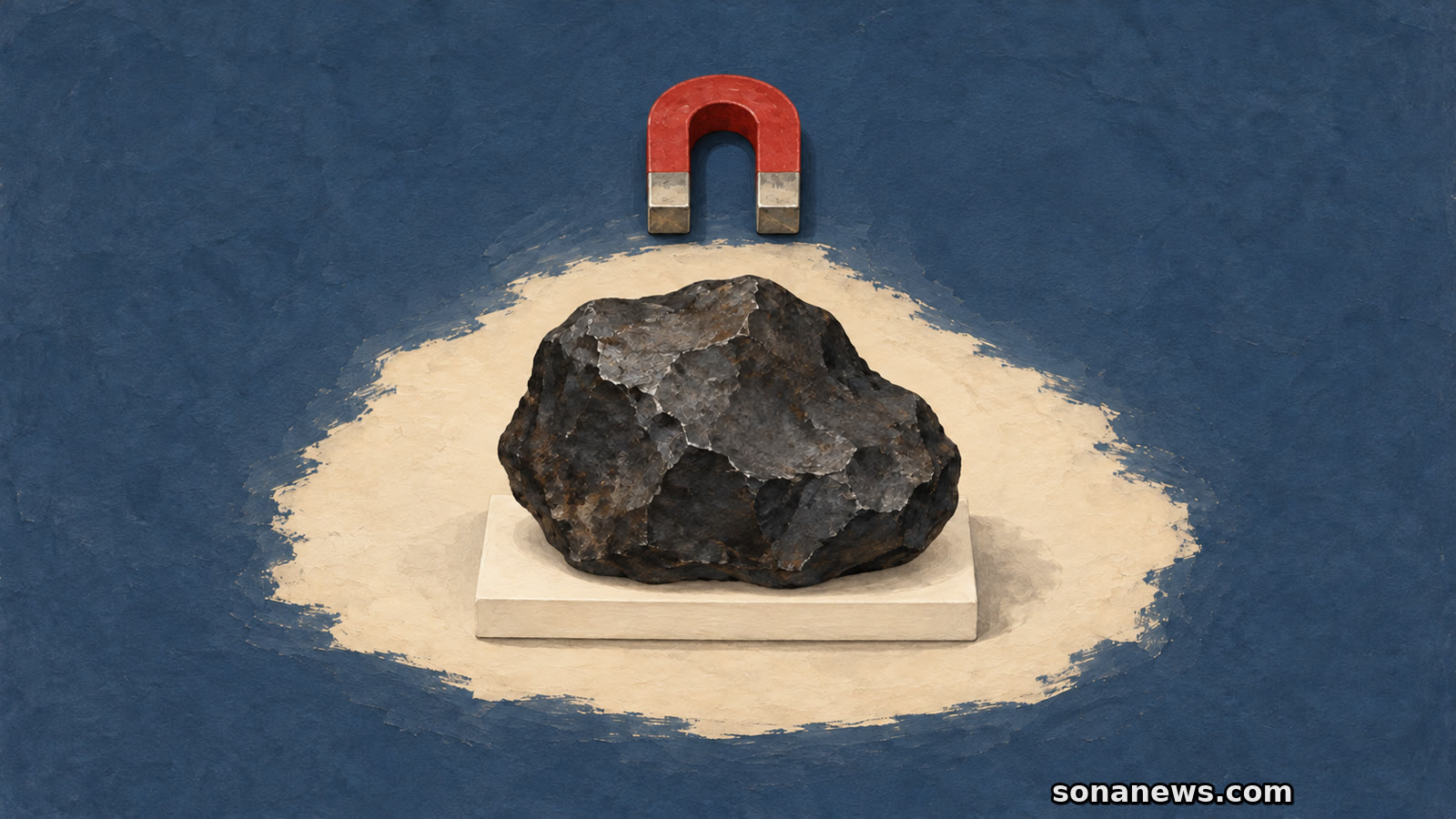

A dark stone turns up in a collection or on a walk. Bringing a magnet to it seems like a simple way to find out whether it came from space. For scientists trying to read a meteorite's magnetic past, that apparently harmless check can alter the evidence before the rock reaches a laboratory.
The problem is not that the magnet breaks the stone. It can overwrite the magnetisation preserved inside it. The specimen may still look the same, while the record researchers hoped to investigate has changed.
This is an established conservation concern, not a newly announced meteorite fall. A 2023 study in the *Journal of Geophysical Research: Planets* combined modelling, a laboratory experiment and measurements of Martian meteorites to show why hand magnets are a poor choice when preserving ancient magnetic information matters. The useful distinction is between finding a promising rock and leaving it suitable for later study.
Many meteorites contain iron-nickel metal and respond to a magnet. But terrestrial rocks can respond too. France's Muséum national d'Histoire naturelle points out that magnetite, an iron oxide found in Earth rocks, can account for a stone's magnetic properties.
The museum's identification guidance also explains why appearance is treacherous. A meteorite may have a thin, dark fusion crust produced during atmospheric entry. Yet weathering, surface coatings and desert varnish can be mistaken for that crust. Density and a metallic-looking surface are not decisive either.
A magnetic response therefore cannot answer the full question, “Is this a meteorite?” It identifies a property that several kinds of material share. Nor does an unusual dark exterior make a rock Martian, valuable or scientifically authenticated.
That matters because the quick check is not necessarily neutral. The museum explicitly advises against applying an ordinary magnet to a possible meteorite, to avoid disturbing its magnetic properties. A test can offer less certainty than the finder expects while changing something a specialist might need.
Some meteorites retain magnetisation acquired earlier in their history. Studying that remanent magnetism can help researchers investigate the environments in which planetary material formed and changed. The study's authors describe applications ranging from the early planet-forming disc to the evolution of small planetary bodies and the history of planetary dynamos, the processes that generate magnetic fields inside planets.
This is not a readable message hidden in every stone. Scientists must establish what a measurement represents, when the magnetisation arose and whether later events altered it. A strong signal measured today is not automatically evidence of a strong magnetic field billions of years ago.
A hand magnet adds another possible event to that history. Its field can change the magnetic state of the material, replacing or obscuring the signal being sought. Removing the magnet does not establish that the original record has survived.
The 2023 paper tested the problem in more than one way. The researchers modelled the field around a hand magnet and its effects on rocks. They also exposed terrestrial basalt to magnetic fields under controlled conditions and measured the resulting changes. This was a laboratory test of remagnetisation, not a claim that the basalt itself was a meteorite.
The most striking case concerned the Northwest Africa 7034 pairing group, associated with the Martian meteorite nicknamed Black Beauty. The material contains zircon crystals with crystallisation ages older than 4.4 billion years. Those crystals make it relevant to questions about the very early history of Mars.
The dates need careful handling. Ancient crystals within a meteorite do not make every feature of the rock equally old, and they do not by themselves establish the age or strength of a preserved magnetic field.
The researchers examined nine paired stones from the group. All nine had been remagnetised by hand magnets, according to the paper. That is a finding about the specimens investigated, not proof that every piece of Martian rock on Earth has lost its original magnetic record.
MIT's account of the work describes the team's unsuccessful search for a magnetically preserved sample among those it studied. The missed opportunity was specific: using that material to recover reliable evidence of ancient Martian magnetism. It was not a finding that the stones had become worthless for all other forms of research.
For a finder, the practical lesson is to avoid using a hand magnet as the first step towards authentication. The study recommends that magnets not be applied during meteorite collection and curation. It identifies low-field susceptibility meters as a non-destructive alternative for classification work.
That is an instrument recommendation for the people doing the work, not a suggestion that every walker needs to buy laboratory equipment. Nor does a meter reading replace the broader task of identifying and characterising a specimen. The immediate priority is preserving the material for an appropriate assessment, rather than trying every home test in sequence.
If a stone has already been exposed to a magnet, that history is relevant information to pass to a specialist. It is not a reason to claim the stone is a meteorite, or to assume that all scientific questions about it are closed. The researchers' modelling can help assess remagnetisation and whether material at depth might remain unaffected; it does not supply a universal safe distance for a household test.
For readers seeking an assessment, the French museum's submission service has country-specific conditions and directs people outside France to specialists in their own countries. Its guidance should not be mistaken for a worldwide, walk-in authentication service.
A possible meteorite is most useful before anyone has forced it to give a quick answer. Leaving the magnet aside preserves a question that a laboratory may later be able to investigate.
Sources
- Foteini Vervelidou, Benjamin P. Weiss and France Lagroix, Hand Magnets and the Destruction of Ancient Meteorite Magnetism, Journal of Geophysical Research: Planets, April 2023
- MIT News, A message to meteorite hunters: Put down your magnets!, 20 April 2023
- Muséum national d'Histoire naturelle, Signaler une possible météorite
Help us improve
Was this article useful?
One anonymous tap helps Sona improve future reporting, headlines and source context.
Up next
NASA has finished integrating solar cells onto the asteroid telescope's sunshade. The milestone is on the ground, with launch still no earlier than September 2027.
Continue readingMore in Space