Why a spacecraft's gold blanket must not be squeezed flat
The shiny wrapping is layered thermal insulation, often coloured by amber film over aluminium. Its performance depends on more than the reflective surface.
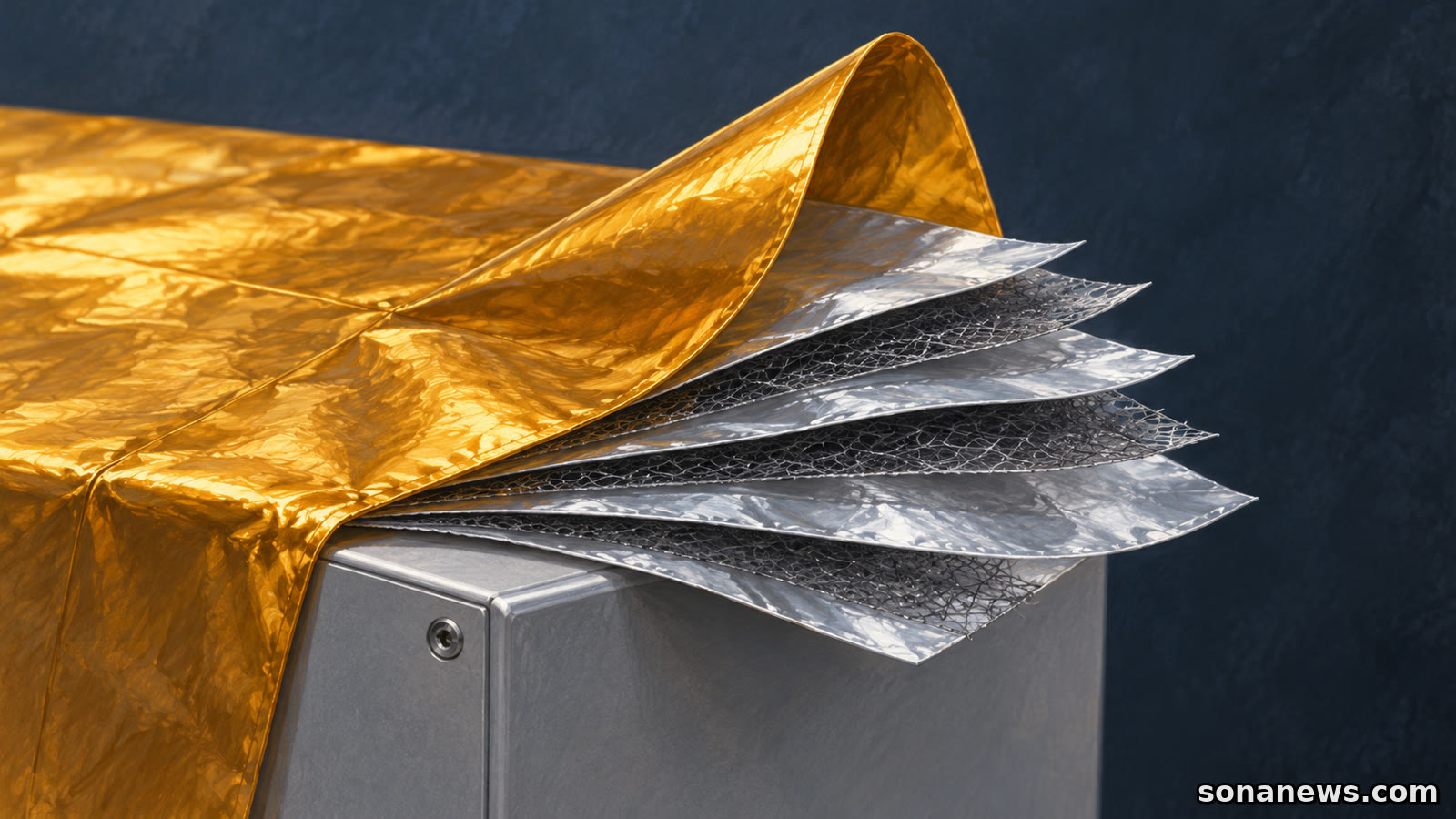

The gold-coloured wrapping on a spacecraft can look like foil pressed around a parcel. But squeezing it into a neater package can undermine the reason it is there. NASA's thermal-control guidance warns that compressing multilayer insulation can drastically reduce its performance by creating a more conductive path through the blanket.
The reflective surface is only part of the design. Beneath it sit thin layers arranged to limit heat exchange, with features that reduce contact between them. A blanket that looks slightly loose is not necessarily unfinished. Its fit, edges and attachment points are engineering decisions, not just matters of presentation.
This is established spacecraft design, not a newly announced material. It offers a useful way to read photographs from mission cleanrooms: the bright wrapping controls how heat moves, rather than acting as a coat of metallic armour.
NASA's Basics of Space Flight guide explains the familiar gold appearance using silvery aluminium behind amber-coloured Kapton film. The combination looks golden. Kapton is a polymer film, not a sheet of the precious metal.
That is not a claim that gold has no role in spacecraft. The same NASA guide notes its use as an efficient infrared reflector for shielding critical components. Nor does every thermal blanket use the same materials or have the same colour. A photograph alone cannot identify the full stack, its coatings or its thermal performance.
The distinction matters because the blanket is a system of surfaces and layers. Describing it simply as gold foil hides both the materials involved and the practical problem it solves. Engineers need to control heat arriving from outside and heat generated by equipment inside, often under changing conditions during a mission.
On Earth, moving air can carry heat away from a warm object. Around a spacecraft in vacuum, there is no surrounding air to provide that convective cooling. Heat can still travel through solid connections by conduction, while exchange with the external environment is driven by radiation.
Sunlight supplies energy. A nearby planet can also contribute reflected sunlight and infrared radiation. Inside the spacecraft, operating electronics generate heat of their own. NASA's small-spacecraft technology review describes thermal control as balancing these inputs with stored energy and heat radiated away.
That makes the idea of space as a universally effective refrigerator misleading. A spacecraft can have equipment that needs protection against cooling and other equipment that needs a route for waste heat to escape. Which problem dominates depends on the hardware, its surroundings and what it is doing.
Multilayer insulation, usually shortened to MLI, limits unwanted radiative exchange. It can help reduce incoming heating and prevent excessive loss of internally generated heat. It does not produce warmth, actively refrigerate an instrument or set a temperature by itself.
NASA's review describes a typical blanket as a durable outer layer surrounding multiple thin inner layers with low infrared emissivity. That property means the surfaces are relatively poor emitters of thermal infrared radiation. The repeated reflective layers limit radiative heat transfer through the stack.
The same review gives a typical range of 10 to 20 inner layers, not a universal specification. Some designs use embossed films; others alternate reflective sheets with fine netting. Both approaches help limit conduction between layers. Perforations or edge venting allow trapped gas to escape as the spacecraft reaches vacuum.
Compressing the stack increases thermal contact. NASA calls the resulting problem a thermally conductive short circuit: heat gains a path through the blanket that the separated-layer arrangement was intended to restrict. This is a thermal comparison, not a warning that the blanket necessarily causes an electrical fault.
It also explains why more material is not automatically better insulation. Layer count, spacing, edge treatment and attachment all matter. The chosen design must fit the hardware without losing the properties that made it useful in the first place.
In a March 2025 NASA podcast, Goddard thermal blanket technician Paula Cain described working from engineers' instructions specifying materials, layer counts, fit and areas to leave clear. Radiators were one example of places a blanket must not cover.
A radiator is deliberately arranged to emit waste heat. Insulating it would work against that job. Other thermal-control tools include coatings, heat-conducting straps, sunshades and heaters. The shiny blanket is one component of this wider arrangement, not a substitute for it.
Cain also described a practical fitting problem during work on the Roman telescope's thrusters: protective covers did not fit correctly after the blankets were installed. The team worked on the covers to provide room without squashing the insulation. That was an account of fabrication work in 2025, not a claim about the telescope's present condition.
NASA's review cautions that MLI can be a poor choice on the exterior of a small satellite packed into a tight deployer. Compression is one concern; snagging during deployment is another. Small blankets also have proportionally more influence from their edges, where heat transfer can undermine performance.
Coatings or tapes can therefore be more suitable in some applications. A spacecraft without conspicuous gold wrapping is not necessarily missing insulation or receiving less careful thermal design.
The next cleanroom picture is worth reading with those distinctions in mind. Colour does not establish composition. A loose-looking surface does not establish poor workmanship. And a deliberately uncovered panel may be doing the opposite job from the blanket beside it: letting heat leave rather than holding it back.
Sources
Help us improve
Was this article useful?
One anonymous tap helps Sona improve future reporting, headlines and source context.
Up next
A familiar identification shortcut can overwrite the magnetism scientists want to study. The damage need not leave a visible mark on the stone.
Continue readingMore in Space