NEO Surveyor's sunshade has two jobs: block glare and make power
NASA has finished integrating solar cells onto the asteroid telescope's sunshade. The milestone is on the ground, with launch still no earlier than September 2027.
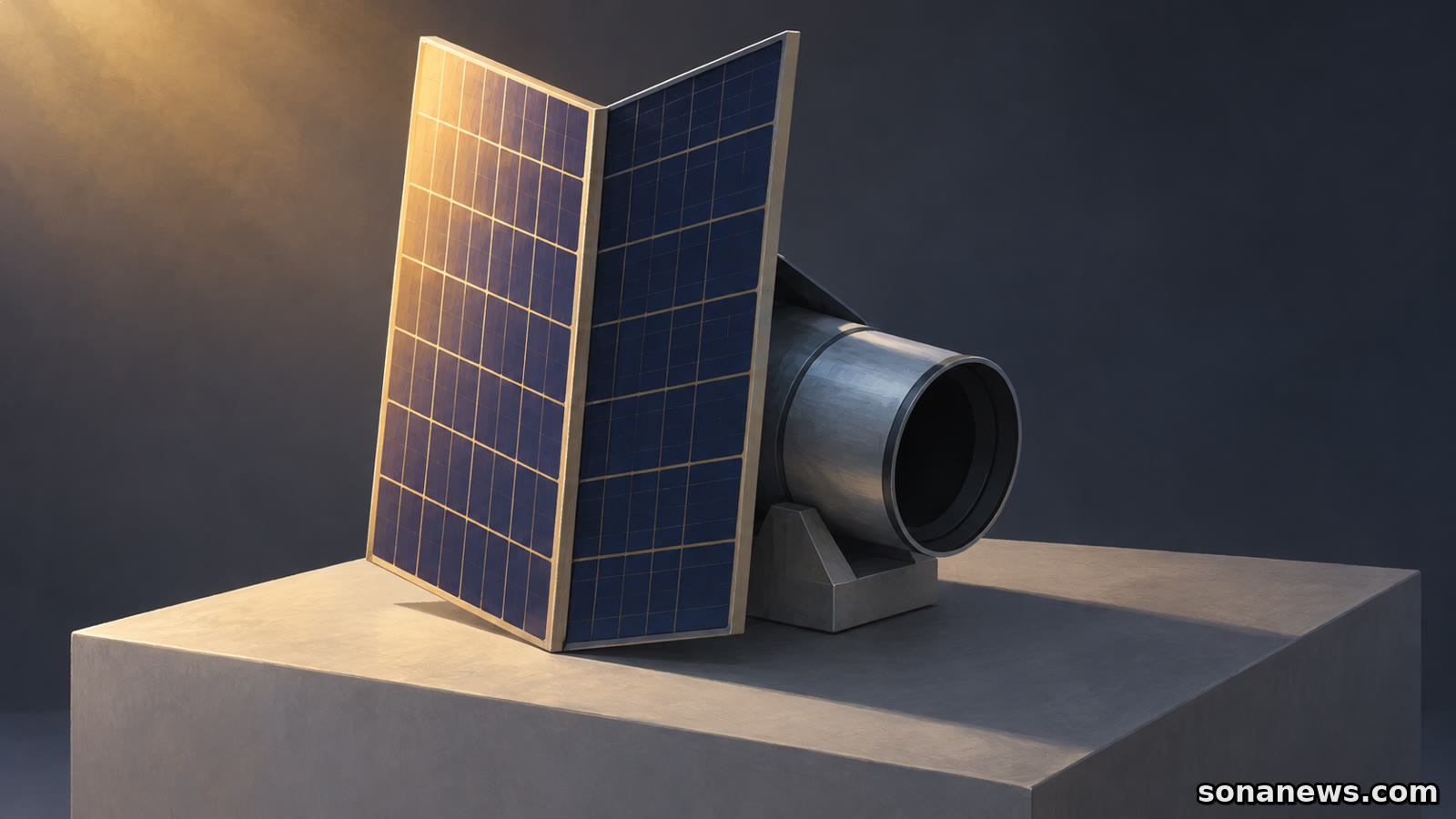

The largest component of NASA's next asteroid-hunting space telescope needs sunlight on one side and protection from it on the other. NEO Surveyor's sunshade is designed to keep glare out of the infrared telescope while its solar cells generate the electricity that runs the spacecraft.
NASA reported on 26 October that teams had completed solar-array integration on the shade. It is a construction milestone, not the start of an asteroid survey: the agency's mission page still lists launch as no earlier than September 2027.
The useful distinction is between building a telescope that can look for difficult-to-find objects and announcing that it has found one. This update concerns the hardware that will make the search possible. It does not identify a new threat to Earth.
The structure stands 6 metres tall and measures 2.4 metres across at its base. NASA describes two flat panels joined at a 23.5-degree angle, carrying 864 interconnected solar cells. The array can produce up to 2 kilowatts and is intended to provide all the electricity needed to charge the spacecraft's onboard batteries.
Those figures describe different parts of the design. The size and panel arrangement concern the shade; the power rating describes what the cells can generate. Neither is a measure of how many asteroids the mission has discovered, nor a guarantee of its eventual detection performance.
The dual use is the point. A component that must face the Sun to block its glare can also carry the cells that harvest sunlight. On the protected side, the telescope needs a view that is not overwhelmed by that light. NASA says the sunshade will also help keep the infrared telescope cool.
The photograph released with the update shows the hardware on the ground. Its dark, patterned surface is not an image of an asteroid field. It is the solar-cell array, being inspected before the spacecraft flies.
NEO Surveyor is intended to find near-Earth asteroids and comets, including objects that are difficult to detect with visible-light observations. Some are dark and reflect little sunlight. That does not mean they emit no useful signal: sunlight heats their surfaces, which then emit infrared radiation.
NASA's mission overview explains that this makes dark objects accessible to sensitive infrared detectors. The telescope is not relying solely on how brightly an asteroid reflects visible light towards an observer.
There is a second difficulty: where an object appears in the sky. Ground-based optical telescopes have a harder time searching regions in the direction of the Sun. NEO Surveyor is designed to help address that gap, as well as to find objects leading and trailing Earth's orbit that can be obscured by solar glare.
That does not mean aiming an unprotected telescope straight into the Sun. The shade is specifically designed to stop sunlight entering the telescope's 50-centimetre-wide aperture. Searching a difficult region of sky and staring directly at the Sun are not interchangeable descriptions of the mission.
Inside the instrument, a pair of detector arrays will image the sky in two infrared bands. NASA says each array produces a 16-megapixel mosaic. Observing the same region in both bands allows the science team to determine an object's temperature and derive an estimate of its size.
The word estimate matters. The mission is not a tape measure sent to each asteroid, and a detection is not by itself a prediction of an impact. NASA says information on an object's location and motion will help improve understanding of the number and nature of potentially hazardous near-Earth objects.
Readers should therefore separate three ideas in future mission updates: finding an object, estimating its physical properties, and assessing its path. A brighter infrared signal is useful observational evidence, not a standalone danger rating.
This is also a survey mission, not an asteroid-deflection demonstration. Its stated job is to improve the search and the information available about objects in Earth's neighbourhood. The sunshade update does not announce an intervention against any particular asteroid.
The component has already passed through several facilities. Applied Aerospace in Stockton, California, built the shade structure. SolAero Technologies in Albuquerque, New Mexico, fitted its solar cells in January. Environmental testing followed at a commercial thermal-vacuum facility in El Segundo, California, in March.
NASA says the assembly reached BAE Systems Space & Mission Systems in Boulder, Colorado, in May. Since then, teams have added coarse Sun sensors used to determine spacecraft attitude, along with temperature sensors, and completed functional and performance testing of the solar array.
Here, attitude means orientation, not an assessment of the mission's readiness. The sensors help establish how the spacecraft is pointing. Their integration and the array tests are concrete progress, but they are not a declaration that the entire observatory has finished every test.
The inspection photographs were taken in July and published in October. Keeping those dates separate avoids turning the release of a picture into a claim that the pictured work happened this week.
For the next update, the question is not whether the sunshade looks finished. It is which milestone NASA can document: component testing, spacecraft integration, launch or observations. For now, NEO Surveyor's distinctive panel is preparing to do two jobs at once, gathering sunlight for power while keeping it out of the telescope.
Sources
Help us improve
Was this article useful?
One anonymous tap helps Sona improve future reporting, headlines and source context.
Up next
A familiar identification shortcut can overwrite the magnetism scientists want to study. The damage need not leave a visible mark on the stone.
Continue readingMore in Space