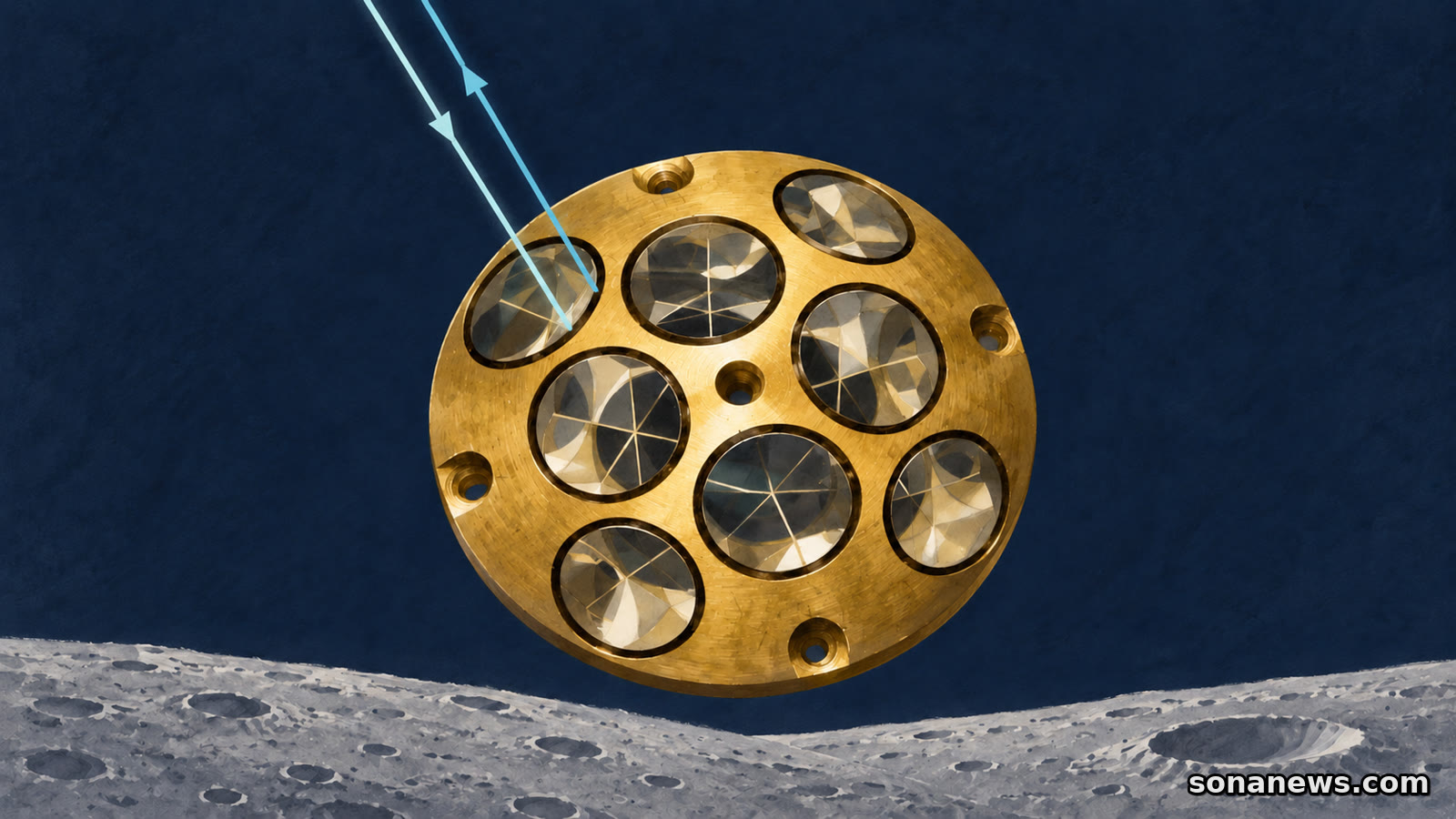
Europa Clipper's radar will read echoes, not photograph an ocean
NASA's probe is due to swing past Earth in December. Its successful Mars radar test explains what it can check now, and what remains unknown beneath Europa's ice.

When Europa Clipper returns to Earth's neighbourhood for a planned gravity assist on 3 December, the spacecraft will still be years from the moon it was built to investigate. NASA targets arrival at Jupiter in April 2030. Yet one of its most important instruments has already practised part of its job, by sending radio waves towards Mars and listening for their return.
That rehearsal helps explain both the promise and the limits of the mission. Clipper's radar is designed to investigate the ice covering Europa and look for water beneath the surface. It is not an underwater camera. A successful test at another planet establishes that the instrument can work in flight; it does not establish what it will find inside a different world.
The distinction matters whenever a mission to an ocean moon is described as a search for life. Europa shows strong evidence for a liquid-water ocean below its icy crust. Clipper's task is to investigate whether the moon has conditions that could support life, not to turn a radar echo into evidence of organisms.
The radar is called REASON, short for Radar for Europa Assessment and Sounding: Ocean to Near-surface. During Clipper's Mars flyby on 1 March 2025, it sent and received radio waves for about 40 minutes over volcanic plains. NASA reported the successful test in August that year, after scientists had examined the full stream of data.
The result included a radargram made from very-high-frequency signals reflected by Mars. Its skyline-like outline represents the topography beneath the spacecraft. It is a processed record of echoes, not a conventional photograph, and certainly not an image of Europa's buried ocean.
Mars was useful because engineers already had decades of observations against which to assess the instrument's behaviour. They collected six gigabytes of data and could compare the returned signals with their models. The flyby was primarily a way to reshape Clipper's trajectory using the planet's gravity, but it also provided an opportunity for a radar rehearsal and calibration of the spacecraft's infrared camera.
This was not testing that engineers had simply forgotten to do before launch. NASA says the flight hardware had to remain sterile and was tested piece by piece in a clean room. A complete echo test would have required a chamber about 76 metres long. Passing a real planet supplied a setting that was difficult to reproduce around the assembled spacecraft on Earth.
At Europa, REASON is intended to investigate the icy shell, which may contain pockets of water. NASA says the instrument may even detect the ocean beneath it. That wording is important: reaching the ocean with radar is a possibility, not a guaranteed mission product.
The shell itself is scientifically valuable. Researchers want to understand its structure and how it interacts with the water below. The radar should also help them examine surface features such as ridges and compare those with features beneath the surface. That connection could help explain how material from the ocean might become incorporated into the ice and reach the moon's exterior.
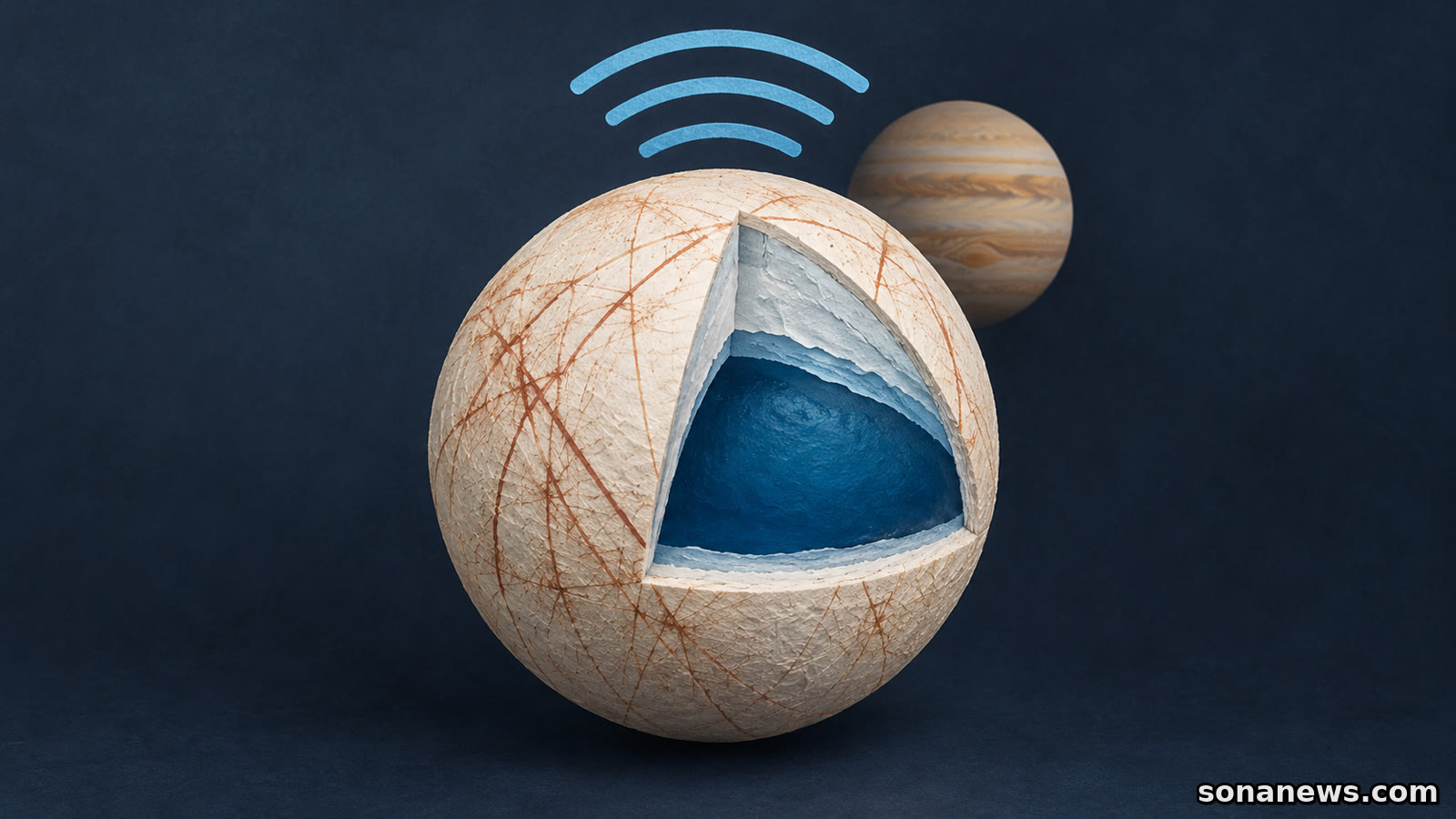
An attractive cutaway drawing can make this look settled: white ice on top, blue water below, a neat boundary between them. Such drawings explain a scientific idea. They do not supply the measurements needed to test it. Clipper has not yet reached Europa, and its future readings will have to be interpreted alongside other observations.
The Mars rehearsal also took place at a different distance from the ground. NASA's account describes radar operations beginning around 5,000 kilometres above Mars and continuing down to 884 kilometres. At Europa, the spacecraft is planned to make passes as close as 25 kilometres above the surface. The test therefore checked instrument performance without reproducing every condition of the eventual investigation.
Clipper carries nine science instruments, plus a gravity experiment using its telecommunications system. The mission is designed to put those measurements together rather than ask radar to answer every question about the moon.
Cameras and spectrometers will examine the surface and its composition. Magnetic and gravity measurements will provide clues about the ocean and deeper interior. A thermal instrument will look for warmer ice, while other instruments will examine particles in Europa's thin atmosphere and surrounding space. Each offers a different way of investigating a world whose most interesting environments may be hidden.
NASA's current plan calls for 49 close Europa flybys from an orbit around Jupiter. It is not a plan to land on the moon, drill through the shell or lower a camera into the water. Success would mean a much better-supported account of Europa's ice, composition, geology and potential habitability, even if the most visually appealing question remains difficult to answer directly.
The next near-term milestone is the planned Earth gravity assist in December. NASA's mission page places that encounter on 3 December 2026, followed by arrival at Jupiter in April 2030. These remain scheduled events. The successful Mars test happened in 2025 and should not be mistaken for a new Europa discovery in 2026.
For readers following the mission, three questions keep updates in proportion. Was an instrument tested, was a new measurement obtained at the target, or was a scientific interpretation drawn from several measurements? Those are different kinds of progress. REASON has cleared a meaningful flight test. The harder task, finding out what Europa's returning echoes actually say about its ice and water, is still ahead.
Sources
- NASA, Europa Clipper mission home. Accessed 18 October 2026. Current mission timeline: planned 3 December 2026 Earth gravity assist, April 2030 Jupiter arrival, 49 Europa flybys, nine instruments and gravity experiment. Supports strong evidence for an ocean and the habitability objective. Timeline remains planned
- NASA/JPL, NASA's Europa Clipper Radar Instrument Proves Itself at Mars, 1 August 2025, updated 20 August 2025. Accessed 18 October 2026. Primary retrospective account of the 1 March 2025 test: roughly 40 minutes, six gigabytes, 5,000-to-884 km altitude range, 76 m hypothetical echo-test chamber, radargram interpretation, potential water pockets and conditional ocean detection. The article's then-current spacecraft distance is deliberately omitted as stale. No new 2026 result is claimed
- NASA, Europa Clipper Mission Overview. Accessed 18 October 2026. Verifies Jupiter orbit, flybys as low as 25 km, ice/composition/geology objectives and complementary instruments. Primary mission documentation, not independent confirmation of future performance
- NASA Jet Propulsion Laboratory, Europa Clipper. Accessed 18 October 2026. Confirms current mission, October 2024 launch, Jupiter-orbit flyby architecture and the instrument roster. The old europa.nasa.gov REASON deep link redirects to the mission homepage and was not counted as a separate instrument source
Help us improve
Was this article useful?
One anonymous tap helps Sona improve future reporting, headlines and source context.
Up next
NASA's sky survey is reading the chemistry of dim, cooling objects between planets and stars. The difficult part is turning their light into reliable atmospheric properties.
Continue readingMore in Space