Japan's MMX is aiming for a Mars moon, not a Mars landing
The mission plans to bring material from Phobos to Earth in 2031. Its sample, paired with measurements from space, could help explain where Mars's moons came from.
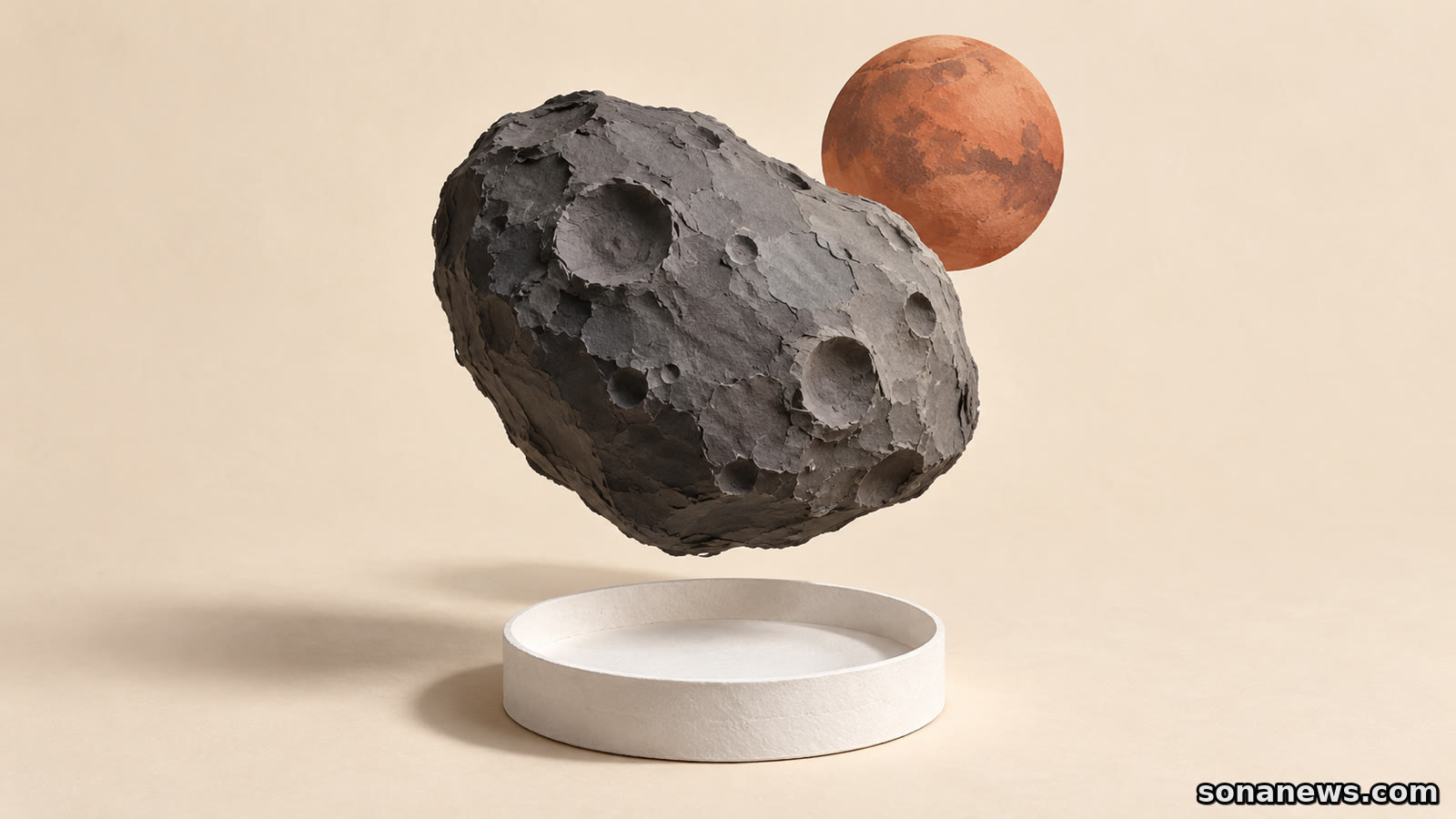

The next Japanese mission heading towards Mars is not trying to land on the planet. Its target is Phobos, the dark, irregular moon circling nearby. MMX, short for Martian Moons eXploration, aims to collect material there and bring it back to Earth, where laboratories could help settle a question that pictures alone have left open: how did Mars acquire its two moons?
JAXA's published launch target is 04:41 JST on 20 October, equivalent to 19:41 UTC on 19 October, from Tanegashima Space Center in Japan aboard an H3 rocket. That remains a schedule, not a completed launch. The agency has reserved further opportunities from 21 October to 7 November, and readers following the flight should check the mission's official updates rather than treat the first target as guaranteed.
The distinction between Mars and its moon matters well beyond the countdown. MMX is designed to return a sample from the Martian system, but it is not collecting rock directly from the surface of Mars. Its scientific value depends on understanding what Phobos is made of, where the sampled material sits and how it reached the moon.
JAXA describes two main explanations for the moons' origins. Phobos and Deimos might be captured asteroids, bodies formed elsewhere and retained by Mars's gravity. Alternatively, they might have formed from debris thrown into orbit after a large object struck Mars.
Those are hypotheses, not destinations already identified on a chemical map. Phobos's dark surface and the way it reflects light resemble carbonaceous asteroids, but resemblance alone does not establish its history. The mission is intended to combine detailed observations with the much closer examination that becomes possible when actual grains reach a laboratory.
Phobos also offers a practical route into this problem. JAXA says returning material from Mars itself is technically difficult because of the planet's stronger gravity. A small moon lets the team build on experience from Japan's Hayabusa and Hayabusa2 asteroid missions. That does not make the journey simple: MMX still has to reach the Mars system, operate close to a small body, collect material and make the return trip.
The choice of Phobos over Deimos brings another advantage. More observational information already exists for the inner moon, including images, topography and temperature measurements. That gives planners a better starting point for assessing landing sites, rather than a promise that the surface holds no surprises.
JAXA's mission overview sets a goal of returning at least 10 grams of material from Phobos. The mass is small, but the sample is only one part of the evidence. Measurements made before landing should help researchers understand how a chosen site relates to the rest of the moon.
One NASA contribution, built by the Johns Hopkins Applied Physics Laboratory, is MEGANE, a gamma-ray and neutron spectrometer. It is designed to measure Phobos's elemental composition using gamma rays and neutrons naturally emitted from the surface. APL explains that these emissions arise from cosmic rays interacting with the surface and from natural radioactivity in the rocks.
This is not a camera that photographs individual chemicals. Nor does the instrument have to fire a beam into Phobos. It measures emissions that carry information about the material below the spacecraft. APL says those measurements will help investigate the moon's origin, study surface processes and support the selection of sampling sites.
That last role is easily lost in the excitement of bringing something home. A laboratory can examine a grain in detail, but the spacecraft's wider observations provide context: what sort of place supplied it, and how that place compares with other areas. Remote measurements and returned material answer related questions at different scales.
The sampling plan also reaches beyond a single scoop. NASA's 15 October mission account describes a pneumatic sampler mounted on one of the spacecraft's landing legs. It is designed to gather surface material using bursts of high-pressure nitrogen gas.
That technology demonstration complements JAXA's coring sampler, which is intended to take material from below the immediate surface. JAXA describes its corer as collecting down to a depth of about two centimetres. The two approaches therefore target different parts of the shallow ground, rather than simply duplicating the same collection method.
Neither device has yet delivered a Phobos sample. NASA's current account puts arrival at Mars in August 2027, sample collection no earlier than December 2028 and delivery to Earth in 2031. Those are planned milestones, dependent on the mission's progress. NASA expects to receive and curate about 15% of the total returned material at Johnson Space Center in Houston, preserving it for research over decades.
A further possibility makes the destination more interesting than a choice between moon science and planet science. JAXA expects Phobos to have accumulated some material ejected from Mars by impacts. Researchers would look within the returned sample for grains of Martian origin, potentially gaining information about the neighbouring planet as well as the moon.
The important word is "look". A planned Phobos collection is not a verified packet of Martian rocks, and any candidate grains would need analysis to establish their origin. It is also not a mission result showing that life existed on Mars. Questions about water, organic material and the development of habitable environments are part of the scientific motivation, not findings already made.
For readers watching the launch, the useful sequence is therefore longer than rocket, arrival and return. MMX first needs observations that can guide sampling and explain the material's setting. If the planned capsule reaches Earth in 2031, those measurements will travel with the grains as evidence. The destination is a small moon; the question is how a planetary system came together.
Sources
- NASA, NASA to Help Unlock Mysteries of Mars' Moons in Upcoming Mission, 15 October 2026. Accessed 18 October 2026. Verifies the current pre-launch status, NASA instrument and sampler contributions, nitrogen collection, 15% curation share, planned August 2027 arrival, collection no earlier than December 2028 and 2031 return. Its confident future tense is rendered as a plan, not a guaranteed outcome
- JAXA, MMX launch schedule, 20 August 2026. Accessed 18 October 2026 and cross-checked against the current mission home page at https://www.mmx.jaxa.jp/en/. Verifies H3 Flight No.10, Tanegashima, 20 October 2026 at 04:41:03 JST and the 21 October to 7 November reserve period. UTC conversion checked with Python zoneinfo; seconds omitted in reader copy without changing the minute
- JAXA, MMX Mission Overview/Mission Flow. Accessed 18 October 2026. Supports the minimum 10g target, Phobos rather than Mars landing, remote observation before collection, small-body exploration rationale and competing origin hypotheses. Planned mission flow is not evidence of completed operations
- Johns Hopkins Applied Physics Laboratory, MEGANE mission overview. Accessed 18 October 2026. Instrument developer's explanation of naturally emitted gamma rays and neutrons, cosmic rays and radioactivity, elemental composition, surface processes and sampling-site context. This is participating-team evidence, not independent replication of a result
- JAXA, MMX Science. Accessed 18 October 2026. Supports Phobos's irregular cratered shape and dark surface, greater existing observational coverage than Deimos, possible material ejected from Mars, and the coring depth. Expected Martian grains are not treated as confirmed sample contents. Source-page distance comparisons and habitability rhetoric are not used as measured findings
Help us improve
Was this article useful?
One anonymous tap helps Sona improve future reporting, headlines and source context.
Up next
NASA's sky survey is reading the chemistry of dim, cooling objects between planets and stars. The difficult part is turning their light into reliable atmospheric properties.
Continue readingMore in Space