France's winter driving rule: tyres fitted or chains carried
In designated French mountain zones, the seasonal rule is not simply a winter-tyre mandate. Check the route, the tyre marking and what is actually in the boot.
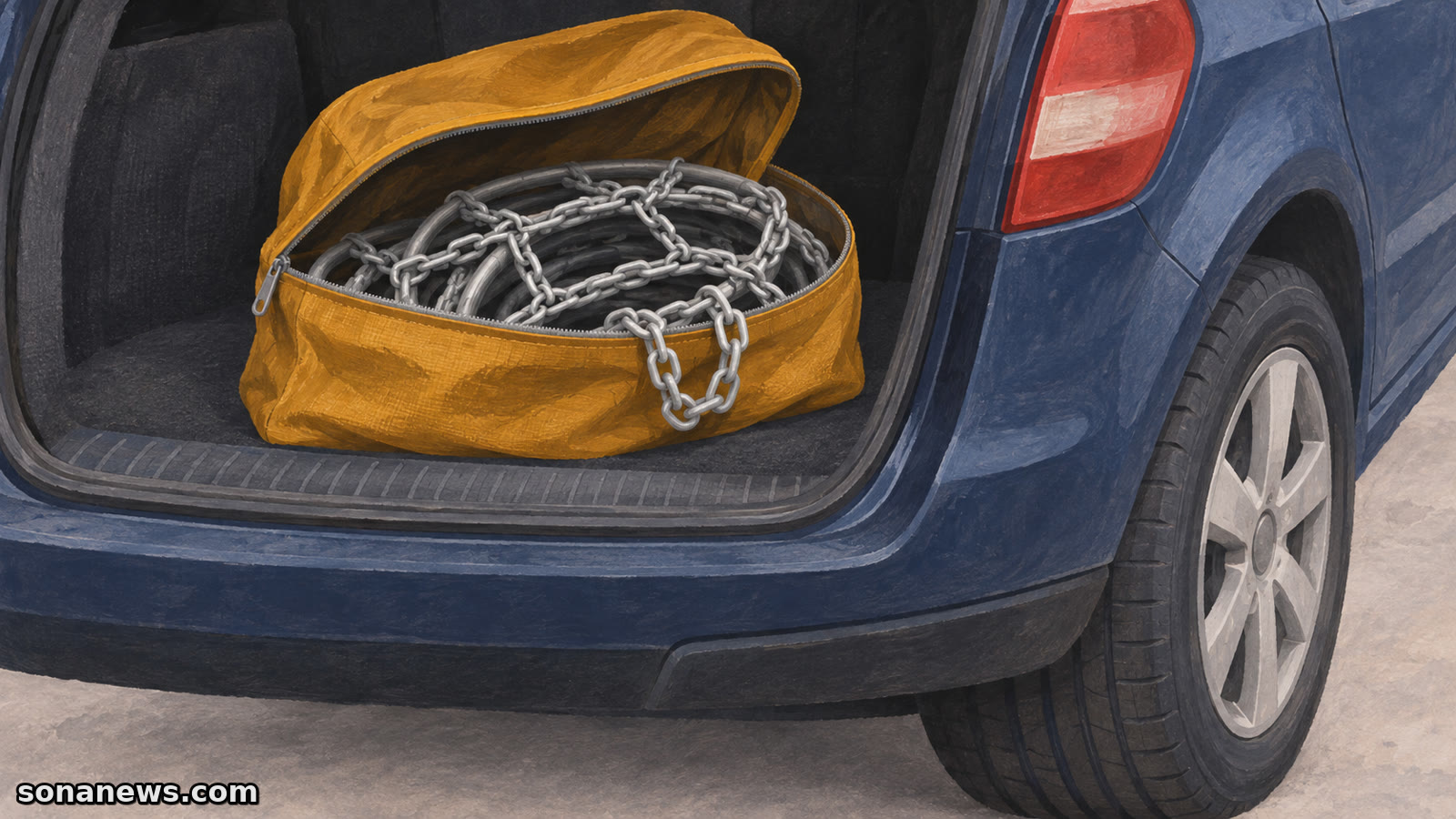

A dry road into the French mountains does not, by itself, remove the winter equipment requirement. From 1 November 2026 to 31 March 2027, ordinary cars travelling through designated zones must either have four qualifying winter tyres fitted or carry suitable snow chains or textile snow socks for at least two driven wheels. That is a choice of equipment, not a blanket instruction to drive on chains throughout the winter.
France's Service Public sets out both options in its current seasonal guidance. The distinction matters for a hired car, a vehicle brought from abroad or a trip that only passes through the mountains: the useful questions are where the route goes, which tyres are fitted and which removable devices are on board. A vague assurance that a car is winter-ready does not answer all three.
This is an existing seasonal rule, not a new nationwide tyre ban. The equipment obligation has operated since 2021. The current November-to-March period is under way, but its geographical scope still depends on designated areas and local orders.
Start with the route, not the weather forecast
The national guidance identifies mountain areas across 34 departments, covering the Alps, Corsica, the Massif Central, Jura, Pyrenees and Vosges. That does not mean every road in all 34 departments has the same designation. Prefects set the relevant communes, and signs mark entry to and exit from the equipment zones.
There are also broad local designations. Savoie's prefecture says the requirement applies throughout its department. Its guidance is useful for understanding why a journey need not reach a ski resort or a visibly snowy pass before the equipment question arises.
For a planned journey, consult the prefecture's current information for the route rather than relying on a list of famous mountain destinations. Service Public links to the national collection of departmental orders. A weather forecast answers a different question: the seasonal zone requirement is not described as applying only once snow begins falling.
This article does not identify a particular road as open or safe. Equipment requirements, access restrictions and the actual conditions for travel are separate checks. An equipped car does not turn a closed road into an available route.
The tyre name is not the tyre test
For the tyre option, ordinary cars need four qualifying winter tyres. Two winter tyres are not the same option with half the equipment. The official guidance also distinguishes qualifying winter tyres from products sold under broader seasonal descriptions.
Since 1 November 2024, only 3PMSF tyres have been accepted as the equivalent of carrying removable anti-skid equipment under this rule. The designation refers to the Alpine symbol showing a three-peaked mountain and a snowflake. Savoie's guidance describes the required tyre markings as that symbol together with an M+S variant.
An M+S marking alone is therefore not enough to take the tyre-only route through the requirement. It does not mean those tyres are banned from sale or use. The official guidance says other types can still be used, but removable equipment must then also be carried for travel in the designated zones during the season.
The same caution applies to the words all-season or all-weather. Savoie explains that those commercial descriptions are not a regulatory definition of a winter tyre. An all-season tyre can qualify if it carries the required marking; the marketing name alone does not establish that it does.
Carrying chains is different from fitting them
The alternative for an ordinary car is to have removable anti-skid devices capable of equipping at least two driven wheels. National guidance includes metal chains and textile snow socks. Savoie says the devices should be on board and ready to use when the route enters a covered area.
The word carry matters. It is not an instruction to fit chains to dry roads for the whole November-to-March period. Conversely, having equipment in the boot does not mean a driver can ignore a road-specific instruction requiring it to be fitted. Savoie's page separately discusses the blue B26 chain sign and specific mandatory-chain wording.
That distinction is worth keeping intact when reading brief travel summaries. A seasonal equipment rule establishes what a vehicle must have; an instruction encountered on a particular road can concern what must be in use. Neither this summary nor the tyre option is a promise that chains can never be required.
Fit matters as much as possession. Service Public expressly says to check that removable devices suit the wheel size and the clearance between wheel and bodywork. An old set in the boot, or a set offered with a different rental vehicle, is not evidence of compatibility with the car being driven.
Make a rental enquiry specific
For a rental booking, a useful enquiry separates the fitted tyres from any supplied chains or socks. Ask which tyre markings the vehicle will have and whether compatible removable equipment is included. The sources do not establish a particular hire company's stock, charges or guarantee, so none should be assumed from a general booking description.
This guide focuses on ordinary passenger cars. The official pages also cover other vehicle categories, with different details for buses and heavy vehicles, especially heavy vehicles towing trailers or semi-trailers. They note a separate exemption for vehicles equipped with studded tyres. Do not transfer the passenger-car summary to a different vehicle without checking its category.
The practical distinction is straightforward: verify the designated route, then establish whether the car meets the fitted-tyre option or carries the appropriate removable equipment. Keep road signs and current local restrictions as a separate check. The contents of the boot and the markings on the tyres matter more than a winter-ready label.
Editorial note. General travel information, not personalised legal advice or a driving-safety assessment. Check current prefectural guidance, road signs and restrictions, and the vehicle and equipment instructions. Meeting an equipment rule is not a guarantee that a route is open or safe.
Sources
Help us improve
Was this article useful?
One anonymous tap helps Sona improve future reporting, headlines and source context.
Up next
A drained stove is not automatically cleared for a flight. US guidance distinguishes fuel-free equipment from fuel containers, and an airline can still refuse used kit.
Continue readingMore in Travel